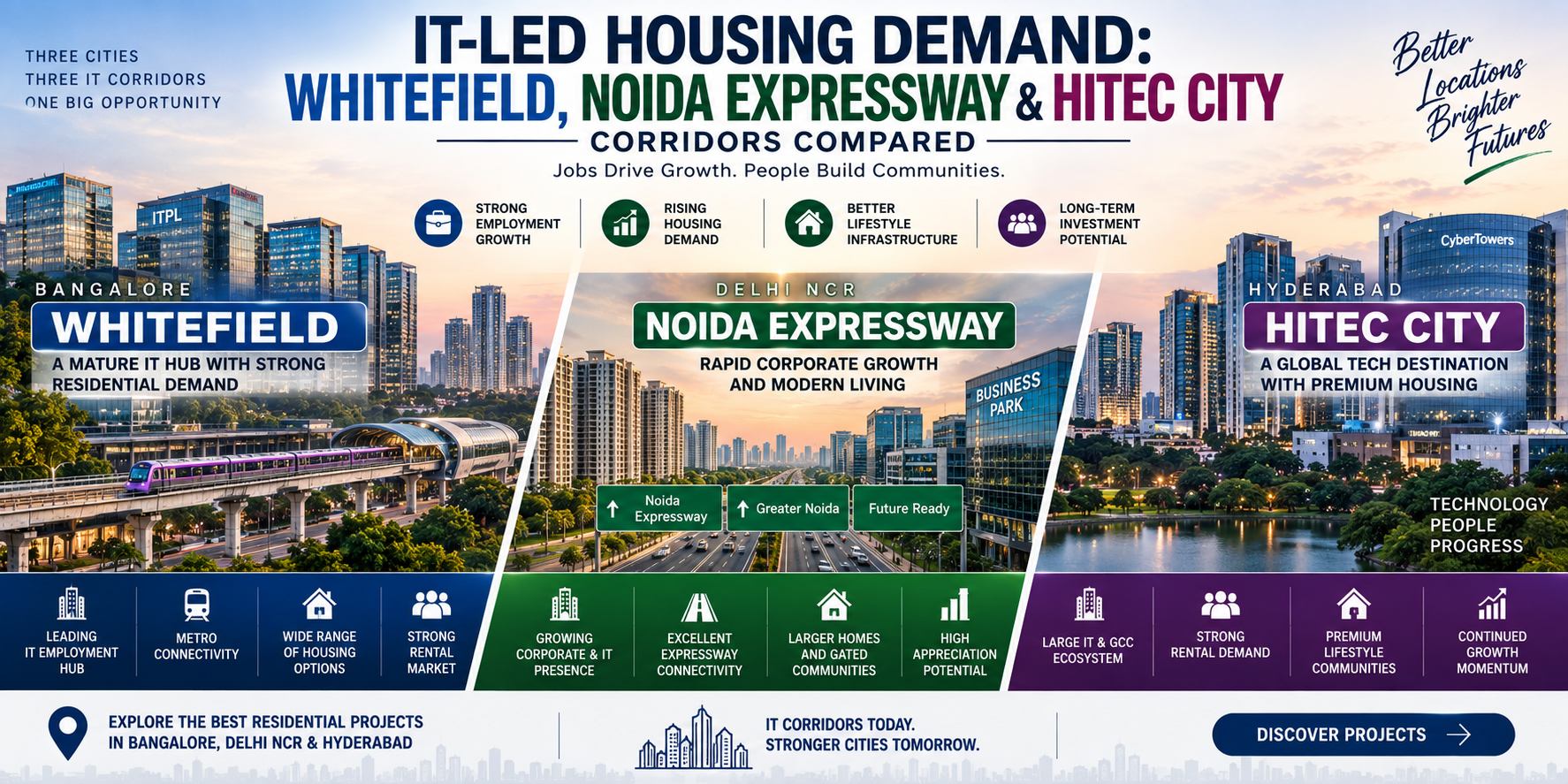
Technology employment has been one of the strongest long-term drivers of urban housing demand in India. When large office clusters expand, they do more than create jobs. They also create demand for apartments, rental housing, schools, retail, transport, restaurants and eventually larger family homes.
*Price and availability are accurate at the time of publishing. Verified by Property Specialists.
That makes the Whitefield vs Noida Expressway vs HITEC City housing comparison highly relevant for buyers in 2026.
All three corridors are major employment-led property markets, but they are at different stages of maturity.
Whitefield in Bengaluru is one of India’s most established technology-residential ecosystems. It combines ITPL and EPIP-area offices, global capability centres, Purple Line metro connectivity, large residential supply and some of Bengaluru’s deepest rental demand.
Noida Expressway is a broader corporate and IT-oriented corridor stretching through sectors such as 125, 126, 127, 128, 132, 135 and adjoining residential clusters. It benefits from direct expressway connectivity, Noida’s growing Grade A office market and access to Greater Noida.
HITEC City in Hyderabad sits at the heart of the city’s western technology ecosystem and connects naturally with Madhapur, Kondapur, Gachibowli, Raidurg and Financial District. It remains one of Hyderabad’s strongest office-demand locations.
Recent office data demonstrates why this comparison matters. JLL reported that Bengaluru accounted for about 24.7% of India’s gross office leasing during H1 2026, the largest share among the major cities. Hyderabad followed among the country’s largest contributors, while Delhi NCR also remained a major office market. Technology companies continued to lead leasing nationally, with GCCs accounting for a particularly large share of demand.
The residential question, however, is not simply which city has more office space.
A buyer evaluating IT corridor apartments should ask:
How close is the home to actual employment?
How diversified is the office base?
Is rental demand strong throughout the year?
How expensive have apartments already become?
Is new residential supply excessive?
Can residents reach offices by metro or expressway?
Is the corridor suitable for families, not just tenants?
Will the property remain liquid if technology hiring slows?
This guide compares Whitefield, Noida Expressway and HITEC City through the relationship between tech employment housing demand, rental depth, property pricing, residential supply and long-term resale potential.
The strongest office corridor property markets generally share one characteristic: thousands of people need to live within practical commuting distance of the employment district.
The process is straightforward.
Stage 1: Offices Create Daily Commuters
Technology companies, GCCs, consulting firms and financial-services businesses bring:
Engineers
managers
product teams
analysts
consultants
support employees
Many initially rent.
Stage 2: Rental Housing Deepens
As more professionals move into the area, demand grows for:
1 BHK homes
2 BHK apartments
shared accommodation
premium rentals
Rental activity gives investors confidence that homes can generate income.
Stage 3: Tenants Become Buyers
Professionals who remain in the city begin purchasing homes close to their workplaces.
Young couples often move from:
rental 1/2 BHK → owned 2/3 BHK
This creates end-user demand rather than only investor demand.
Stage 4: Families Upgrade
As income and household size rise, demand moves toward:
Larger 3 BHK homes
Premium gated communities
Better schools
Clubhouses
Larger balconies
Better social infrastructure
This is how an employment corridor evolves into a complete residential market.
Why GCC Growth Matters in 2026
India’s office market continues to be driven heavily by Global Capability Centres.
CBRE reported that GCCs accounted for about 43% of H1 2026 office leasing, while JLL recorded strong GCC growth and technology as the largest sectoral contributor.
This matters for residential property because GCC employment often includes:
higher-income professionals
longer-term corporate operations
product and research teams
senior management
That profile can support premium rental and ownership demand.
But IT Demand Does Not Remove All Risk
Technology-led housing can still weaken if:
hiring slows
companies reduce headcount
residential prices rise faster than incomes
too much new supply enters the market
JLL noted that Bengaluru’s Q2 2026 residential sales declined 6% quarter-on-quarter, partly because rising values were reducing affordability and premium launches were crowding out mid-segment buyers.
Therefore, strong employment helps—but price discipline still matters.
2. Whitefield: Deepest Technology-Housing Ecosystem of the Three
Whitefield is arguably the most mature example of employment-led housing demand among these three corridors.
It has evolved from an IT suburb into a large residential-commercial city within Bengaluru.
Whitefield also connects with the broader Outer Ring Road and East Bengaluru employment ecosystem.
BLR Atlas currently tracks 403 residential projects in Whitefield, including 328 apartment developments, illustrating the sheer scale of the residential market. It places the 2026 locality market average around ₹10,680 per sq. ft. and highlights Whitefield as a major IT-demand and rental market.
Current Residential Pricing
Different portals calculate asking prices differently, so exact levels vary.
Magicbricks’ July 2026 data places multistorey apartments in Whitefield at approximately ₹13,375 per sq. ft., while Housing.com shows a locality average of about ₹12,683 per sq. ft.
The important trend is that Whitefield is no longer a low-cost IT suburb.
What This Means for Buyers
Whitefield’s major advantage is demand certainty.
Potential buyers and tenants include:
IT professionals
GCC employees
senior managers
professionals working around ORR
families already living in East Bengaluru
investors seeking rental demand
This gives Whitefield one of the broadest residential audiences.
However, rising capital values can reduce rental yields because rents may not increase as fast as purchase prices.
New Supply Remains Significant
JLL reported Whitefield among the primary submarkets receiving new residential supply in Q2 2026.
That creates a mixed situation.
Advantages:
More project choice
Better amenities
More branded developers
Risks:
Resale competition
Higher launch premiums
Too many similar apartments
Whitefield Buyer Profile
Whitefield may be strongest for:
Technology professionals
Long-term end-users
Families wanting metro + office connectivity
Investors prioritising rental depth
For buyers researching Bangalore residential projects, Whitefield remains one of the most defensible employment-led residential markets—but buyers need to watch entry price carefully.
Noida Expressway operates differently from Whitefield.
It is not one concentrated technology district. Instead, it is a linear corporate corridor running alongside the Noida–Greater Noida Expressway.
Key office sectors include:
Sector 125
Sector 126
Sector 127
Sector 132
Sector 135
surrounding institutional and commercial districts
This gives the Noida Expressway housing market strong office access while still allowing buyers to live across a wider range of residential sectors.
Current Office Demand
JLL reported that Delhi NCR recorded 3.55 million sq. ft. of gross office leasing in Q2 2026, up 16% quarter-on-quarter.
Noida accounted for around 30% of NCR net absorption, and Noida Expressway was specifically identified alongside NH-8, Golf Course Extension and SBD Delhi as one of the key submarkets driving office absorption.
This is an important signal.
It shows that Noida Expressway is not merely a residential corridor—it has real office-market depth.
Who Is Creating Demand?
Occupier demand includes:
IT/ITeS
flexible workspace companies
consulting
corporate services
technology firms
GCC-related activity
Delhi NCR’s Q2 leasing mix was more diversified than Bengaluru’s, with flex operators leading followed by consulting and IT/ITeS.
That diversification can reduce dependence on only one employment sector.
Current Residential Pricing
Magicbricks’ July 2026 data shows average multistorey apartment asking prices along Noida–Greater Noida Expressway at approximately ₹14,146 per sq. ft.
That puts the corridor broadly in a similar or higher asking-price band than Whitefield, although direct comparison is imperfect because portals use different inventory pools.
Residential Advantages
Noida Expressway offers:
Wide roads
Direct expressway access
Metro accessibility in several sectors
Large gated communities
Relatively modern infrastructure
Access toward Greater Noida
Another major strength is unit-size diversity.
Buyers can choose:
Compact 2 BHK
Standard 3 BHK
Premium large 3 BHK
4 BHK
luxury formats
Resale Considerations
The corridor benefits from a large NCR buyer pool.
A resale property may attract:
Noida-based families
Delhi buyers
corporate professionals
upgrade buyers
investors
However, sector quality varies.
An occupied project close to an office hub may have strong liquidity, while a newer isolated sector could take longer to mature.
Noida Expressway Buyer Profile
The corridor may be especially suitable for:
NCR corporate professionals
Families wanting larger homes
Buyers prioritising road connectivity
Investors seeking diversified employment demand
Buyers comparing Delhi NCR upcoming projects should consider the exact office-to-home commute rather than assuming every expressway sector behaves similarly.
4. HITEC City: Hyderabad’s Most Concentrated Technology Housing Demand Engine
HITEC City is one of India’s most mature technology employment districts.
Its residential influence extends well beyond the official HITEC City boundaries into:
Madhapur
Kondapur
Kothaguda
Raidurg
Gachibowli
Financial District
western Hyderabad
This creates a large interconnected tech employment housing demand zone.
Office Demand Remains Strong
JLL reported Hyderabad office gross leasing of about 1.77 million sq. ft. in Q2 2026, up 4.7% year-on-year.
Knight Frank’s earlier H1 2025 data also showed how dominant HITEC City remains within Hyderabad’s office market: HITEC City alone accounted for 61% of leasing in the city’s SBD locations, with very low vacancy in Grade A buildings.
The underlying employment base includes:
IT services
GCCs
product companies
consulting
BFSI
global corporates
JLL reported that GCCs accounted for 42.9% of Hyderabad’s Q1 2026 office leasing.
Why This Supports Housing
Professionals working in HITEC City can choose housing across a large western Hyderabad belt.
This creates demand in:
HITEC City itself
Kondapur
Madhapur
Gachibowli
Narsingi
Kokapet
Unlike a purely speculative corridor, the residential demand is tied to a mature employment ecosystem.
Current Prices
Magicbricks’ July 2026 data places HITEC City multistorey apartments at an average of approximately ₹11,311 per sq. ft.
Housing.com shows an average around ₹10,422 per sq. ft., again illustrating that different portal datasets produce different exact levels.
The practical conclusion is that HITEC City has become a premium but not necessarily ultra-luxury-only market.
Housing Supply Is Spreading Outward
The strongest new residential development is increasingly located in nearby areas rather than directly inside the core office district.
This includes:
Kokapet
Neopolis
Narsingi
Tellapur
Financial District
This creates a broader residential catchment but also introduces significant competing supply.
HITEC City Buyer Profile
The corridor is strong for:
Hyderabad IT professionals
GCC employees
corporate families
investors focused on rental demand
buyers wanting proximity to western employment hubs
Its major strength is the concentration of employment.
Its major risk is that surrounding premium residential areas are adding large amounts of new supply.
5. Whitefield vs Noida Expressway vs HITEC City: Direct Housing Comparison
The best way to compare Whitefield vs Noida Expressway vs HITEC City housing is through multiple factors rather than price alone.
Employment Depth
Whitefield
Very strong technology ecosystem with Bengaluru’s broader GCC and IT market behind it.
Noida Expressway
Strong and increasingly diversified corporate demand across IT, flex, consulting and services.
HITEC City
Extremely concentrated technology and GCC employment base within western Hyderabad.
Current Office Momentum
Market
Current Office Signal
Bengaluru / Whitefield ecosystem
Bengaluru led India leasing share in H1 2026
Noida Expressway / NCR
Noida accounted for ~30% of NCR net absorption in Q2
Hyderabad / HITEC ecosystem
Hyderabad leasing grew 4.7% YoY in Q2
Current Residential Asking-Price Indicators
Corridor
Approx. 2026 Portal Asking Rate
Whitefield
₹12,700–₹13,400/sq. ft.
Noida Expressway
~₹14,150/sq. ft.
HITEC City
₹10,400–₹11,300/sq. ft.
These are portal-level asking indicators, not registered transaction prices, and should not be directly compared as exact valuations.
Rental Demand
Whitefield: Very strong due to IT employment, metro access and long-established residential stock.
Noida Expressway: Strong near office sectors and established residential clusters; demand is more sector-dependent.
HITEC City: Very strong in the core western employment ecosystem, particularly among technology and corporate professionals.
Family Suitability
Whitefield offers:
Schools
malls
hospitals
metro
long-established residential neighbourhoods
Noida Expressway offers:
Wide roads
larger apartments
gated communities
NCR-wide connectivity
HITEC City offers:
short commute to major offices
mature social infrastructure
access to surrounding premium residential markets
Direct Comparison
Factor
Whitefield
Noida Expressway
HITEC City
IT employment depth
Excellent
Strong
Excellent
GCC exposure
Very High
Growing
Very High
Rental demand
Very Strong
Strong
Very Strong
Metro/transit
Strong
Good
Strong urban connectivity
Residential choice
Very High
Very High
High
Price pressure
High
High
Moderate–High
Supply competition
High
Sector-specific
High in western Hyderabad
Family infrastructure
Mature
Mature in stronger sectors
Mature
Resale depth
Very Strong
Strong
Strong–Very Strong
Overall Employment-Housing Strength
For pure technology employment depth:
Whitefield and HITEC City lead.
For diversified corporate demand:
Noida Expressway has an advantage.
6. Which Corridor Is Better for Buyers, Investors and Long-Term Families?
There is no universal winner.
The right office corridor property depends on the buyer’s objective.
Choose Whitefield If:
You work in Bengaluru’s eastern technology ecosystem
Whitefield’s biggest strength is the depth of both employment and residential demand.
Its biggest challenge is pricing.
A buyer should avoid paying a large premium simply because the project carries a prestigious brand.
Choose Noida Expressway If:
You work in Noida or the broader NCR corporate ecosystem
You want larger apartment options
Expressway connectivity matters
You want diversified employment demand
You value NCR-wide resale buyer depth
Its biggest strength is choice.
Its risk is micro-market inconsistency.
A project in one expressway sector can perform very differently from another.
Choose HITEC City If:
You work in Hyderabad’s western technology ecosystem
Short office commute matters
Rental demand is important
You want access to Gachibowli and Financial District
You prefer Hyderabad’s premium western residential market
Its greatest advantage is concentrated employment.
Its main risk is premium supply growth across Kokapet, Neopolis and neighbouring locations.
Investor Decision Framework
Buyer Priority
Strongest Candidate
Deepest tech ecosystem
Whitefield
Diversified corporate employment
Noida Expressway
Core tech-office proximity
HITEC City
Strong rental depth
Whitefield / HITEC City
Larger homes across budgets
Noida Expressway
Metro-oriented tech housing
Whitefield
Premium western-city ecosystem
HITEC City
NCR-wide buyer pool
Noida Expressway
What Matters More Than the City
Regardless of corridor, buyers should prefer properties with:
Multiple employment hubs nearby
Practical commute
Strong occupancy
Good maintenance
Recognised developer
Mainstream configuration
Healthy rental demand
Rational entry price
This combination generally provides better protection if office-market conditions change.
FAQs About Whitefield vs Noida Expressway vs HITEC City Housing
1. Which IT corridor has the strongest housing demand?
Whitefield and HITEC City both have exceptionally deep technology-led housing demand because they are mature employment centres. Whitefield benefits from Bengaluru’s broader GCC ecosystem, while HITEC City anchors western Hyderabad’s technology corridor. Noida Expressway also has strong demand but its occupier base is more diversified across IT, consulting, flex and other corporate sectors.
2. Is Whitefield still good for property investment in 2026?
Whitefield remains one of Bengaluru’s strongest employment-led residential markets. However, asking prices have risen substantially, with current portal indicators around ₹12,700–₹13,400 per sq. ft. Buyers should therefore focus on project quality, metro access and entry valuation rather than assuming future appreciation will match previous years.
3. Is Noida Expressway an IT corridor?
Yes, but it is broader than a pure IT corridor. Noida Expressway includes technology, consulting, flexible workspace, institutional and corporate office demand. JLL reported that Noida accounted for about 30% of Delhi NCR net office absorption in Q2 2026, with Noida Expressway among the major absorption corridors.
4. Does HITEC City have stronger rental demand than Kokapet?
HITEC City generally benefits from more immediate office-driven rental demand because it sits inside the mature employment core. Kokapet offers newer premium supply and Financial District access, but its rental dynamics can depend more heavily on individual project positioning and ticket size.
5. Which corridor is more affordable in 2026?
On the reviewed portal asking-price indicators, HITEC City appears lower on a per-square-foot basis than Whitefield or Noida Expressway. However, configuration size, project brand and exact locality can reverse that comparison. Buyers should compare total ticket size rather than only rate per square foot.
6. Which corridor has better long-term resale demand?
Whitefield has arguably the most consistent technology-led resale depth. Noida Expressway benefits from the large NCR buyer pool, while HITEC City benefits from a mature western Hyderabad employment ecosystem. In all three markets, the exact project, price and micro-location matter more than the corridor name alone.
Conclusion: Which IT-Led Housing Corridor Offers the Strongest Opportunity?
The Whitefield vs Noida Expressway vs HITEC City housing comparison shows why employment corridors continue to be among India’s strongest residential markets.
Whitefield offers the deepest combination of technology jobs, metro connectivity, rental demand and mature residential infrastructure. Bengaluru also remains India’s leading office-leasing market, supported heavily by GCCs and global occupiers.
Noida Expressway offers a broader corporate ecosystem rather than a purely technology-led market. Its strengths include major office absorption, direct expressway connectivity, larger residential options and access to the wider Delhi NCR buyer pool.
HITEC City remains one of Hyderabad’s most powerful housing-demand engines because of its concentrated technology and GCC employment base. Hyderabad continued to record healthy office leasing in 2026, reinforcing the long-term residential relevance of the western corridor.
For buyers evaluating IT corridor apartments, the strongest decision should combine:
Employment depth
Office-to-home commute
Public transport
Rental demand
Family infrastructure
Apartment ticket size
Residential supply
Project occupancy
Future resale depth
Developer credibility
The core principle is simple:
Office demand can create housing demand, but the best property is the one where employment access, affordability and residential quality remain balanced.
Buying close to a famous tech park is not enough. The strongest tech employment housing demand investment is usually a home that professionals can afford, families can comfortably live in and future buyers will still want when it is time to resell.

 By Upcoming Property