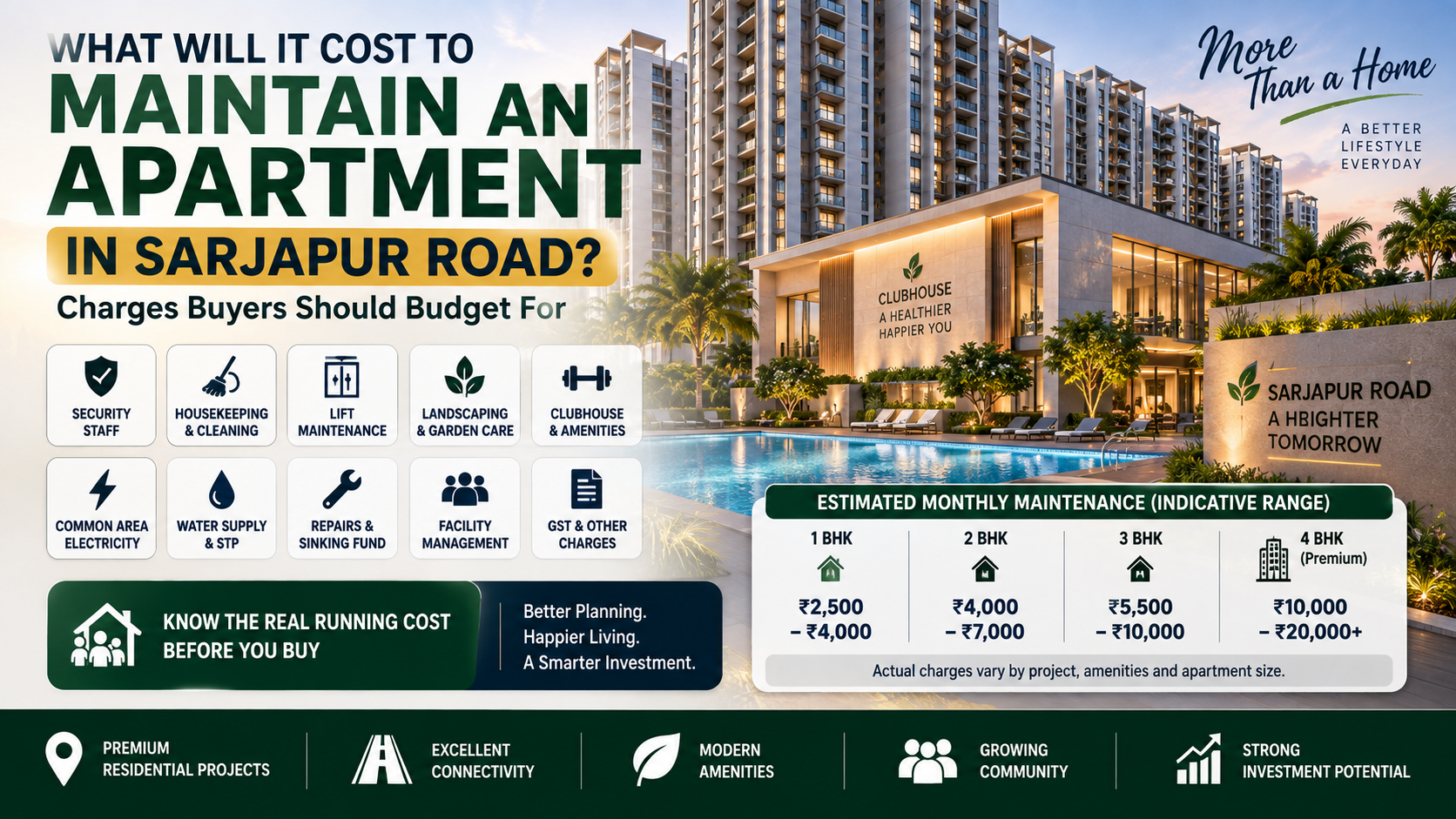
Buying an apartment on Sarjapur Road involves much more than paying the purchase price and home-loan EMI. Once possession begins, owners also need to budget for monthly society maintenance, sinking-fund contributions, common-area electricity, security, housekeeping, lift maintenance, landscaping, clubhouse upkeep, water systems and occasional special repairs.
*Price and availability are accurate at the time of publishing. Verified by Property Specialists.
That makes apartment maintenance cost in Sarjapur Road an important part of the home-buying decision.
For a typical gated community, the difference between ₹4,000 and ₹10,000 monthly maintenance may not seem significant while evaluating a ₹1.5–₹2.5 crore apartment. But over ten years, even ₹8,000 per month equals ₹9.6 lakh before considering inflation, special assessments or major repairs.
Premium projects can cost considerably more.
The actual maintenance charges Sarjapur Road depend on:
Apartment size
Number of towers
Total units
Project density
Clubhouse size
Swimming pools
Elevators
Landscaping
Security staffing
Power backup
Water management
Sewage-treatment plant
Property-management standards
Age of the community
Real listings already demonstrate this variation. A recent Sarjapur Road listing for a 1,474 sq. ft. 3 BHK in Sattva Signet showed ₹7,500 monthly maintenance, while a 2,026 sq. ft. home in Greenwood Regency showed around ₹3,500 monthly maintenance. These are individual listing examples, not fixed locality-wide rates, but they show how project structure can matter as much as apartment size.
Sarjapur Road is also an increasingly expensive residential corridor. Magicbricks’ July 2026 locality data placed the average quoted rate for multistorey apartments at approximately ₹12,181 per sq. ft., with project-level pricing varying considerably.
As property values and amenity standards rise, buyers should evaluate not just acquisition cost but total ownership cost.
This guide explains the main society charges Sarjapur Road buyers should budget for, provides illustrative 2 BHK and 3 BHK running-cost calculations, explains GST treatment and identifies hidden charges that are often overlooked before possession.
1. How Much Are Monthly Apartment Maintenance Charges on Sarjapur Road?
There is no standard maintenance charge applicable to every Sarjapur Road apartment.
Different residential communities calculate maintenance differently. Some use a flat monthly fee per apartment, while others calculate charges based on super built-up area, carpet area or a combination of fixed and variable components.
For planning purposes, buyers can think in broad indicative bands rather than expecting one universal number.
Illustrative 2026 Planning Range
For a reasonably modern gated apartment community on Sarjapur Road, buyers may want to budget approximately:
Apartment Type
Illustrative Monthly Maintenance Budget
Compact 1/2 BHK
₹3,000–₹5,500
Standard 2 BHK
₹4,000–₹7,000
Standard 3 BHK
₹5,500–₹9,000
Large 3 BHK
₹7,000–₹12,000
Premium 4 BHK / luxury community
₹10,000–₹20,000+
These are budgeting estimates, not official project quotations.
Actual charges can fall outside these ranges.
Why One 3 BHK May Cost ₹4,000 and Another ₹10,000
Consider two apartments of similar size.
Project A
1,500 apartments
4 swimming pools
50,000 sq. ft. clubhouse
landscaped gardens
multiple towers
extensive security
centralized facility management
numerous elevators
Project B
250 apartments
small clubhouse
one basic gym
limited landscaping
fewer lifts
simpler common areas
Project A may have higher total operating expenses—but because costs are distributed across more households, the per-unit charge may still remain reasonable.
Conversely, a luxury low-density project with only 200 apartments and expensive amenities may require much higher per-home contributions.
Real Sarjapur Road Examples
A recent listing in Sattva Signet, Ambalipura showed:
3 BHK
1,474 sq. ft.
₹75,000 rent
₹7,500 monthly maintenance
A Greenwood Regency listing in Kaikondrahalli showed:
3 BHK
approximately 2,026 sq. ft.
₹65,000 rent
₹3,500 monthly maintenance
This shows why buyers should never estimate maintenance purely from apartment size.
Per-Square-Foot Model
Some projects may quote maintenance as a per-square-foot rate.
For illustration:
Apartment Size
₹4/sq. ft.
₹5/sq. ft.
₹6/sq. ft.
1,100 sq. ft.
₹4,400
₹5,500
₹6,600
1,400 sq. ft.
₹5,600
₹7,000
₹8,400
1,700 sq. ft.
₹6,800
₹8,500
₹10,200
2,000 sq. ft.
₹8,000
₹10,000
₹12,000
Again, these are illustrative calculations, not recommended rates.
Buyers comparing projects in Sarjapur Road should ask each developer or existing residents’ association for the current maintenance budget and basis of calculation rather than relying on marketing estimates.
2. What Exactly Do Society Maintenance Charges Pay For?
Many buyers see one figure on the monthly statement but do not understand how that money is used.
The apartment maintenance cost in Sarjapur Road generally covers a wide range of shared services.
Security
Security is one of the largest recurring expenses in many gated communities.
It may include:
Main-gate security
Tower guards
CCTV monitoring
Visitor management
Patrol staff
Vehicle-access management
Large communities may require dozens of security personnel across multiple shifts.
Housekeeping
Common-area cleaning typically covers:
Tower lobbies
Staircases
Basement
Clubhouse
Corridors
Common washrooms
Parking areas
Internal roads
More towers and amenities mean larger staffing requirements.
Lift Maintenance
High-rise towers can contain multiple passenger and service elevators.
Annual maintenance contracts, electricity, repairs and component replacement can become significant expenses.
A 30- or 40-storey apartment project generally has more expensive vertical-transportation infrastructure than a four-storey residential block.
Landscaping
Sarjapur Road’s newer communities increasingly market large open spaces and landscaped environments.
Maintenance may include:
Gardeners
Irrigation
Plants
Lawn care
Tree trimming
Water features
Landscape lighting
Large landscaped townships can therefore carry meaningful recurring costs.
Clubhouse and Amenities
Clubhouse expenses may include:
Gym maintenance
Swimming-pool cleaning
Sports facilities
Indoor-game rooms
Air conditioning
Common-area electricity
Cleaning
Equipment servicing
A project marketed with 50 or 60 amenities is not automatically better financially.
Every operating amenity eventually needs maintenance.
Water Infrastructure
Water-related expenses may include:
Borewell systems
Water treatment
Pumps
Tank cleaning
Sewage-treatment plant
Rainwater harvesting
Tanker water, where required
Water security is especially relevant in Bengaluru.
A society dependent heavily on tanker water could face materially higher operating expenses.
Common Electricity
This may cover:
Lifts
Basement lighting
Street lights
Clubhouse
Water pumps
STP
Security systems
Common-area ventilation
Facility Management
Premium projects may employ professional facility-management companies.
These costs can improve service quality but also increase the monthly bill.
Typical Expense Structure
Expense
Usually Included in Maintenance?
Security
Yes
Housekeeping
Yes
Lift AMC
Yes
Landscaping
Yes
Clubhouse basic upkeep
Usually
Pool maintenance
Usually
Common electricity
Usually
STP / water pumps
Usually
Major capital repair
Often separate
Apartment electricity
No
Apartment interiors
No
Personal internet
No
The headline society charges Sarjapur Road number therefore needs to be understood alongside what is actually included.
3. GST on Apartment Maintenance: When Can It Apply?
GST is one of the most misunderstood parts of apartment maintenance.
The Central Board of Indirect Taxes and Customs has clarified the conditions under which contributions to a Resident Welfare Association can attract GST.
According to CBIC’s clarification, an RWA is generally liable to charge GST on monthly contributions only when both conditions are satisfied:
Monthly contribution exceeds ₹7,500 per member, and
The RWA’s annual aggregate turnover is ₹20 lakh or more.
Important: Both Conditions Matter
CBIC’s table effectively works like this:
RWA Annual Turnover
Monthly Contribution
GST Position
₹20 lakh or less
Above ₹7,500
Exempt
₹20 lakh or less
₹7,500 or below
Exempt
Above ₹20 lakh
₹7,500 or below
Exempt
Above ₹20 lakh
Above ₹7,500
GST may apply
Buyers should therefore not assume:
“Maintenance ₹8,000 means GST automatically applies.”
That is incomplete.
The RWA’s turnover also matters.
Why This Is Relevant for Large Sarjapur Road Communities
Many large residential associations manage substantial annual budgets.
A development with 1,000 apartments charging ₹5,000–₹8,000 per month can easily handle significant annual collections.
Therefore, buyers in large premium communities should explicitly ask:
Is GST currently applicable?
Is the quoted maintenance GST-inclusive?
Is GST charged separately?
What components are included?
Example
Suppose the monthly maintenance contribution is ₹9,000.
If the RWA meets the applicable turnover condition and the contribution is taxable, GST can materially increase the monthly cash outflow.
A buyer planning only ₹9,000 may therefore underestimate the actual expense.
Maintenance Advance Collected by Builders
Developers may also collect advance maintenance before the residents’ association takes control.
Buyers should check:
Duration covered
Whether GST applies
Whether unused funds transfer to the association
How the rate was determined
Whether the developer’s facility-management fee is separate
Don’t Confuse Maintenance GST With Property Purchase GST
These are separate matters.
Maintenance taxation relates to services supplied through the association or maintenance agency, while GST on under-construction residential property follows different rules.
The safest approach is to review the actual invoice structure applicable to the specific community.
4. Sinking Fund, Corpus Fund and Major Repairs Buyers Often Forget
Monthly maintenance is only one part of the total apartment running cost Sarjapur Road.
Long-term owners may also contribute to reserve funds that pay for major capital expenditure.
Sinking Fund
A sinking fund is designed to accumulate money for major future replacement or repair.
It may eventually be used for:
Elevator replacement
External painting
Waterproofing
Pumps
Generator replacement
Major clubhouse repairs
Roof repair
Fire-system replacement
These costs can be substantial.
Without a reserve fund, residents may face sudden large special assessments.
Corpus Fund
Some developers collect a one-time corpus or maintenance fund during possession.
Examples may include:
₹50,000
₹1 lakh
₹2 lakh
or considerably more in premium projects
The amount varies by project.
Buyers should ask whether:
The corpus is refundable
Interest is earned
It transfers to the association
It is separate from advance maintenance
Major Special Assessments
Imagine a 10-year-old project needs ₹4 crore of major repair work.
If there are 800 apartments, an equal division could mean around ₹50,000 per apartment.
In reality, contribution structures may vary.
This is why older-project buyers should examine the association’s finances before purchasing a resale apartment.
Typical Long-Term Costs
Cost
Frequency
Routine maintenance
Monthly
Sinking fund
Monthly/annual
Corpus
Often one-time
Painting
Every several years
Lift modernization
Long cycle
Waterproofing
Periodic
Clubhouse upgrades
Periodic
Road resurfacing
Periodic
Why New Buyers Often Ignore These Costs
Developers naturally focus on:
Apartment price
Amenities
Floor plan
location
clubhouse
But an owner will eventually pay for maintaining every amenity being marketed.
A fountain, heated pool, elaborate landscape or multiple sports courts can add lifestyle value—but they also create lifecycle costs.
Premium Amenities = Premium Maintenance?
Often yes, although not always.
Large communities can achieve economies of scale.
For example, a 4-acre luxury project with 150 apartments may have higher per-unit costs than a 30-acre township with 2,000 apartments.
This is why density matters.
Questions to Ask
Before purchasing, ask:
What is the monthly maintenance?
Is there a sinking fund?
Is corpus collected?
Is club membership separate?
Are major repairs covered?
How often can rates be revised?
Who manages the property?
These questions are particularly important in high-end projects where the future maintenance charges Sarjapur Road could become a meaningful monthly expense.
5. What Should a 2 BHK, 3 BHK and Premium Apartment Owner Budget Annually?
A practical way to understand maintenance is to convert monthly charges into annual ownership cost.
Below are illustrative planning models.
Example 1: Standard 2 BHK
Assume:
Apartment: 1,150 sq. ft.
Monthly society maintenance: ₹5,000
Sinking/reserve fund: ₹10,000 per year
Minor miscellaneous charges: ₹5,000
Estimated annual community-related cost:
Item
Annual Cost
Maintenance
₹60,000
Reserve/sinking fund
₹10,000
Misc. society charges
₹5,000
Total
₹75,000/year
That is approximately ₹6,250 per month on an annualized basis.
Example 2: Standard 3 BHK
Assume:
Apartment: 1,500 sq. ft.
Maintenance: ₹7,500/month
Reserve fund: ₹15,000/year
Miscellaneous: ₹7,500
Item
Annual Cost
Maintenance
₹90,000
Reserve fund
₹15,000
Misc. society charges
₹7,500
Total
₹1,12,500/year
Annualized cost: roughly ₹9,375/month.
This ₹7,500 maintenance assumption also matches the maintenance figure shown in the recent Sattva Signet rental listing noted earlier.
Example 3: Premium Large 3 BHK
Assume:
Apartment: 1,900 sq. ft.
Monthly maintenance: ₹10,000
Sinking fund: ₹20,000
Miscellaneous amenity expenses: ₹10,000
Total:
₹1.5 lakh annually
before personal electricity, internet or apartment repairs.
A ₹10 lakh cheaper apartment with consistently higher maintenance may not remain cheaper over a long ownership period.
6. Hidden Apartment Running Costs Beyond Society Maintenance
The monthly maintenance invoice is not the complete apartment running cost Sarjapur Road.
Owners should also account for expenses paid directly.
Electricity
Apartment electricity depends on:
AC usage
Family size
Working from home
Appliances
Water heaters
Larger apartments usually have higher electricity consumption.
Water
Water may sometimes be included within maintenance, partially metered or billed separately.
In tanker-dependent communities, costs can rise substantially during shortages.
Property Tax
Property tax is an annual ownership expense separate from society maintenance.
Buyers should confirm current BBMP or applicable local-authority assessment depending on property jurisdiction.
Internet and DTH
A modern household may spend:
₹800–₹2,000+ per month on broadband
additional TV/streaming subscriptions
These are small individually but part of total housing cost.
Apartment Repairs
Owners remain responsible for internal:
Plumbing
Electrical work
AC servicing
Appliance replacement
Interior repairs
Painting
Parking Charges
Some projects may charge separately for:
Additional parking
Visitor parking
EV charging
parking-related maintenance
Clubhouse Usage
Certain premium services may not be included in general maintenance.
Examples:
Paid sports coaching
banquet booking
guest rooms
spa
premium classes
EV Charging
Electric-vehicle owners should ask:
Is individual metering available?
Is installation separately charged?
Does the association impose infrastructure fees?
Domestic Help and Lifestyle Costs
While not technically property maintenance, large gated communities can indirectly raise household costs through:
domestic help
drivers
sports coaching
children’s activities
Full Monthly Ownership Budget Example
A family in a 3 BHK could plan:
Expense
Illustrative Monthly Budget
Society maintenance
₹7,500
Electricity
₹2,500
Internet
₹1,000
Apartment repairs reserve
₹1,000
Annual sinking/other charges averaged monthly
₹1,500
Total basic running budget
₹13,500/month
Water, property tax and optional lifestyle expenses may increase this.
This is why buyers should evaluate the property as an ongoing financial commitment rather than a one-time purchase.
FAQs About Apartment Maintenance Cost in Sarjapur Road
1. What is the average apartment maintenance cost in Sarjapur Road?
There is no single official average. As a practical planning assumption, standard gated-community apartments may require roughly ₹4,000–₹9,000 per month, while larger or luxury communities can go significantly higher. Individual listings show real variation: one recent Sattva Signet 3 BHK listing showed ₹7,500 maintenance, while a Greenwood Regency listing showed ₹3,500.
2. Are maintenance charges based on apartment size?
Often, but not always. Some societies calculate maintenance per square foot, while others use equal charges or a mixed structure. Buyers should ask whether the calculation uses carpet area, super built-up area or a fixed per-unit rate.
3. Does GST apply to apartment maintenance charges?
CBIC has clarified that RWA maintenance contributions generally become taxable when monthly contributions exceed ₹7,500 per member and the association’s annual aggregate turnover is ₹20 lakh or more. Both conditions matter.
4. What is usually included in society maintenance charges?
Typical components include security, housekeeping, lifts, landscaping, common electricity, clubhouse upkeep, water systems, sewage-treatment infrastructure and facility management. Exact inclusions vary from project to project.
5. What is a sinking fund in an apartment society?
A sinking fund is a reserve created for major future expenses such as lift replacement, painting, waterproofing, generators or structural/common-area repairs. Buyers should check whether it is included in monthly maintenance or collected separately.
6. Is a project with lower monthly maintenance always better?
No. Very low maintenance may sometimes result in weaker service quality or insufficient reserves. Buyers should evaluate both the amount and what it covers. A well-maintained project can protect rental demand and resale value over the long term.
Conclusion: How Much Should Sarjapur Road Buyers Budget for Maintenance?
The apartment maintenance cost in Sarjapur Road should be treated as a permanent part of home ownership—not a minor post-possession charge.
For practical budgeting, a standard apartment owner may want to keep roughly ₹5,000–₹10,000 per month available for society maintenance depending on apartment size and community type, while luxury projects can exceed this materially.
Beyond the monthly invoice, buyers should also budget for:
Sinking fund
Corpus contribution
Special repair assessments
Property tax
Electricity
Water
Internal repairs
Internet
EV infrastructure where applicable
The biggest mistake is comparing two homes purely by purchase price.
For example, an apartment with a ₹7,500 monthly maintenance bill costs ₹90,000 every year before additional property expenses. Over ten years, that becomes ₹9 lakh even without inflation.
Before buying, ask the developer or association for:
Current maintenance rate
Calculation basis
GST treatment
Advance maintenance period
Sinking-fund structure
Corpus amount
Last annual budget
Major planned capital expenses
For a long-term homeowner, these details can matter almost as much as the floor plan.
The strongest purchase is therefore not simply the apartment with the lowest maintenance charges Sarjapur Road, but the one where the monthly cost is reasonable for the level of security, infrastructure, landscaping, amenities and long-term upkeep being provided.

 By Upcoming Property