Sarjapur Road is entering another major residential construction cycle. For buyers, the key question is no longer whether new projects are coming. The more important question is how much new housing supply in Sarjapur Road is likely to reach the market between 2026 and 2030, where that supply is concentrated, and how it could affect pricing, resale competition, infrastructure and homebuyer choice.
*Price and availability are accurate at the time of publishing. Verified by Property Specialists.
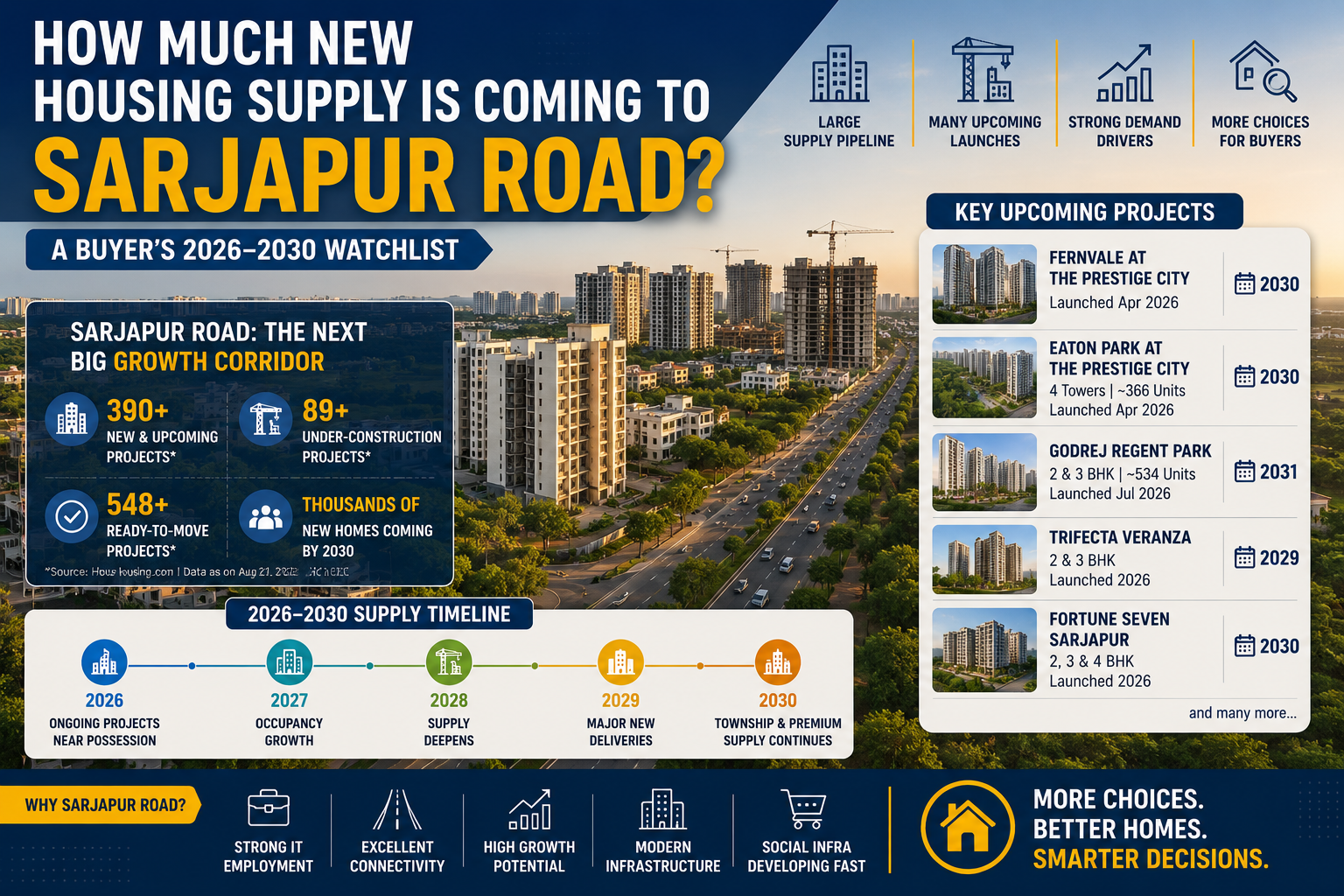
As of August 2026, current property portals show a very large active pipeline across the broader Sarjapur Road market. Housing.com lists more than 390 new and upcoming projects across Sarjapur Road, alongside 89+ under-construction projects, although these portal counts include projects at different scales, stages and micro-locations and should not be treated as a precise unit-supply forecast.
Other market trackers also show substantial activity. Magicbricks lists more than 150 pre-launch and upcoming projects in the Sarjapur Road market, while specialist project trackers continue to monitor well over 100 upcoming and ongoing developments across the broader corridor.
This indicates one clear trend:
Sarjapur Road is likely to remain one of East Bengaluru’s largest residential supply corridors through the second half of the decade.
For buyers, this is positive because more supply creates:
More builder choice
More floor-plan options
More launch-stage competition
More bargaining opportunities in selected projects
More resale competition later
Greater pressure on roads and utilities
Greater need to differentiate one project from another
1. How Large Is the Sarjapur Road Housing Pipeline in 2026?
The residential supply Sarjapur Road story is not based on one or two major developments. It is a combination of township-scale projects, premium towers, mid-market apartments, plotted communities and projects extending deeper into Sarjapur, Kada Agrahara and the Sarjapur–Attibele side.
This is important because project-count data alone can be misleading.
A 200-unit boutique apartment project and a 2,000-unit township may each appear as “one project,” but their effect on future supply is completely different.
What Current Market Data Shows
As of August 21, 2026, Housing.com reports:
390+ new and upcoming projects in the Sarjapur Road market
89+ under-construction projects
548+ ready-to-move projects
A very large overall active inventory pool across new, resale and completed stock
Magicbricks separately identifies more than 150 upcoming/pre-launch developments around Sarjapur Road.
These numbers should not be added together because the portals overlap heavily. However, together they confirm that the housing pipeline Sarjapur Road is deep and diversified.
Where Is Supply Coming From?
The strongest supply clusters include:
Main Sarjapur Road
Kada Agrahara
Dommasandra
Sompura
Sarjapur town
Sarjapur–Attibele Road
Prestige City belt
Wider Varthur–Sarjapur corridor
Peripheral plotted and villa locations
The Economic Times recently identified Sarjapur Road and Kada Agrahara as one of Bengaluru’s active 2026 expansion zones, highlighting developments such as Godrej Regent Park, Prestige City, Trifecta Veranza and other active residential communities across the wider eastern corridor.
Why Sarjapur Keeps Attracting New Supply
Developers continue to launch here because the corridor has several demand drivers:
Wipro and nearby employment campuses
Connectivity towards ORR
Access towards Bellandur and Marathahalli
Connectivity towards Electronic City
Proximity to Whitefield through eastern routes
Large availability of developable land compared with mature central locations
Strong demand from technology professionals
Established buyer familiarity with Sarjapur Road
Supply Does Not Mean Immediate Possession
A buyer must distinguish between:
Launch supply and completed housing supply.
A project launched in 2026 may not become habitable until 2029, 2030 or even 2031.
Therefore, the real 2026–2030 question is:
How much of today’s launched inventory will actually become completed, occupiable housing before 2030?
That requires analysing possession timelines rather than simply counting launches.
2. Which New Projects Could Add Major Housing Supply Between 2026 and 2030?
Several active and recently launched projects illustrate the scale of future apartments Sarjapur Road.
The corridor is seeing both large township-linked phases and independent residential developments with possession dates stretching through 2027, 2028, 2029 and 2030.
Fernvale at The Prestige City
Fernvale at The Prestige City was launched in April 2026 and is currently marketed with possession around 2030.
Its presence is important because it demonstrates how the Prestige City ecosystem continues to add fresh inventory rather than functioning as a one-time launch.
Eaton Park at The Prestige City
Eaton Park is another 2026 addition to the Sarjapur Road supply pipeline.
Because its possession extends beyond 2030, it shows that the current launch cycle will continue adding completed supply even after this watchlist period ends.
Trifecta Veranza
Magicbricks currently lists Trifecta Veranza as a newly launched Sarjapur Road project with:
2 and 3 BHK options
Possession around December 2029
Ticket sizes broadly around ₹1.08–1.66 crore at the time of listing
TG Legacy
TG Legacy is another newly launched development listed with possession around December 2028.
Binary Etania
Binary Etania is currently shown as a 3 BHK-focused project with possession around December 2029.
Fortune Seven Sarjapur
Housing.com lists Fortune Seven Sarjapur as a new launch on the Sarjapura–Attibele Road side, with:
2, 3 and 4 BHK apartments
Possession around March 2030
Current pricing roughly from ₹97.59 lakh to ₹1.73 crore
Sobha-Linked Supply
Current market listings also show substantial Sobha-linked housing delivery scheduled through the end of the decade.
For example, some Sarjapur Road projects and township phases are currently marketed with possession around 2029–2030.
What These Projects Tell Buyers
The pipeline is not concentrated in one year.
Instead, new supply is staggered across:
2026 completions
2027 completions
2028 completions
2029 completions
2030 completions
2031+ completions
This gradual delivery can help prevent all units from hitting the market simultaneously, but it also means buyers will continue facing competing new launches for several years.
3. What Could the 2026–2030 Supply Timeline Look Like?
A useful way to understand new housing supply in Sarjapur Road is to separate the pipeline by likely possession period.
The following is not a definitive official unit forecast. It is a buyer-oriented supply watchlist based on current project timelines.
2026: Existing Pipeline Starts Converting Into Occupied Housing
Some ongoing projects have possession timelines in late 2026.
Examples currently listed include projects such as Coevolve Florenza and ARS Zurich Phase 2, although actual handover should always be verified with the developer and Karnataka RERA.
What Buyers May See in 2026
Completion of older under-construction stock
New launches replacing completed inventory
Early occupancy in previously launched projects
More resale stock from investors
Continued land acquisition farther along the corridor
2027: Larger Occupancy Growth
Projects currently showing 2027 possession dates include developments such as:
Keya The Urban Forest
Parth Atmosphere
DSR The Address
Other mid-sized residential communities
2027 may therefore be an important year for actual population growth.
This matters because completed units create direct demand for:
Schools
Roads
Retail
Water
Public transport
Healthcare
Local commercial services
2028: Supply Deepens
Projects such as TG Legacy and other active under-construction developments currently indicate handover schedules around 2028.
By this stage, buyers may begin seeing stronger separation between:
Established Sarjapur communities
Newer extension markets
Premium township zones
Budget and mid-market outer locations
2029: Major New-Launch Delivery Cycle
Several newer developments currently have possession dates in 2029.
Examples include:
Trifecta Veranza
Binary Etania
Vrushabadri Winter Park
Sobha-linked residential supply
This could create meaningful resale and rental competition because many original buyers will begin receiving possession at roughly similar times.
2030: Township and Premium Supply Continues
By 2030, projects such as:
Fernvale at The Prestige City
Eaton Park at The Prestige City
Fortune Seven Sarjapur
Other township phases
are expected, based on current marketed timelines, to contribute additional finished inventory.
2031 and Beyond
The current launch cycle does not stop in 2030.
Godrej Regent Park currently has possession scheduled in 2031, while a proposed large SNN development indicates a possible 2027 launch and a tentative completion timeline around 2032, though approvals and unit numbers remain unsettled.
This is important.
The residential supply Sarjapur Road story is likely to remain active even beyond the 2026–2030 period.
4. Will More Housing Supply Reduce Sarjapur Road Property Prices?
Many buyers assume that more supply automatically means falling prices.
Real estate is more complicated.
High supply can slow price appreciation if housing additions exceed genuine end-user demand. But Sarjapur Road also benefits from one of Bengaluru’s deepest employment catchments.
Therefore, price behaviour will depend on the relationship between:
The Economic Times recently cited an indicative Sarjapur Road price range of around ₹8,000–12,500 per sq. ft. for many projects, while premium developments can move higher.
This wide range already shows that Sarjapur Road is not one uniform property market.
High Supply Can Benefit Buyers
A large housing pipeline Sarjapur Road can create:
Current project portals track hundreds of new and upcoming developments, while multiple large projects have possession dates stretching from 2027 through 2030 and beyond.
This creates both opportunity and risk.
For buyers, more supply means more choice.
For investors, more supply means stronger competition.
For developers, it means project differentiation will matter more.
For Sarjapur Road itself, it means the next stage of growth must be supported by equally strong upgrades in:
Roads
Water
Public transport
Schools
Healthcare
Retail
Drainage
Key Takeaways for Sarjapur Road Buyers
Sarjapur Road has a very large active residential pipeline.
Current portals show hundreds of new and upcoming projects.
Project counts should not be confused with unit-supply forecasts.
New housing delivery is spread across 2026–2030 and beyond.
Prestige City continues to add new phases.
Eaton Park is currently expected around 2030.
Fernvale is another 2030-linked Prestige City phase.
Godrej Regent Park adds more premium supply but currently has possession beyond 2030.
Trifecta Veranza and Binary Etania add 2029-targeted inventory.
Fortune Seven Sarjapur is currently targeted for 2030.
More supply can improve buyer choice.
More supply can also increase resale competition.
Location quality will matter more as inventory expands.
Water and road capacity should be investigated carefully.
Compare competing projects within a 3–5 km radius.
Check units per acre.
Do not assume launch price equals best value.
Review RERA timelines.
Compare final acquisition cost, not only base price.
Stronger projects may continue outperforming generic supply.
For broader city-level comparison, buyers can explore Bangalore residential projects and compare Sarjapur Road with Whitefield, North Bengaluru, Devanahalli and other major growth corridors.
Frequently Asked Questions
1. Is a lot of new housing supply coming to Sarjapur Road?
Yes. Current property portals track hundreds of new and upcoming developments across the wider Sarjapur Road market, although these counts include projects of different sizes and should not be interpreted as an exact number of future apartments.
2. Will too much supply reduce property prices on Sarjapur Road?
Not necessarily. Higher supply can reduce pricing power for weak projects, but strong employment demand and differentiated projects may continue to appreciate. Micro-location and project quality are likely to matter more.
3. Which years could see the most housing completions?
Current project timelines indicate meaningful completions across 2027, 2028, 2029 and 2030. Several recent launches have possession scheduled toward the end of this period.
4. Which major projects are adding new supply?
Current and recent projects include Godrej Regent Park, multiple Prestige City phases such as Fernvale and Eaton Park, Trifecta Veranza, TG Legacy, Binary Etania and other developments across the wider Sarjapur corridor.
5. Is Sarjapur Road oversupplied?
It is better described as a high-supply market rather than automatically oversupplied. Whether supply becomes excessive depends on future sales velocity, employment growth, infrastructure and actual project completion.
6. Is new housing supply good for end users?
Usually yes, because it creates greater choice in floor plans, builders, project stages and budgets. However, end users should still prioritise water, roads, school access and commute.
7. Is high supply risky for investors?
It can be. Investors may face more competing resale and rental inventory, especially if multiple similar projects complete at the same time.
8. Should buyers prefer ready-to-move projects in a high-supply market?
Ready projects can be attractive because buyers can evaluate actual water conditions, traffic, maintenance and community quality. New launches may offer wider choice but involve more construction and market risk.
9. What is the biggest risk in Sarjapur Road’s housing pipeline?
One major risk is whether physical and social infrastructure keeps pace with residential population growth.
10. Should buyers wait until 2029 or 2030?
Not necessarily. Waiting may increase choice but could also mean higher prices in stronger projects. Buyers should make decisions based on personal needs, project quality and financial readiness rather than trying to time the market perfectly.
11. How should I compare two Sarjapur Road projects?
Compare exact location, commute, water source, builder, RERA timeline, project density, maintenance, carpet efficiency and competing nearby supply.
12. Will new projects continue after 2030?
Very likely. Current projects already have possession timelines stretching into 2031 and even tentative development schedules extending beyond that period.

 By Upcoming Property