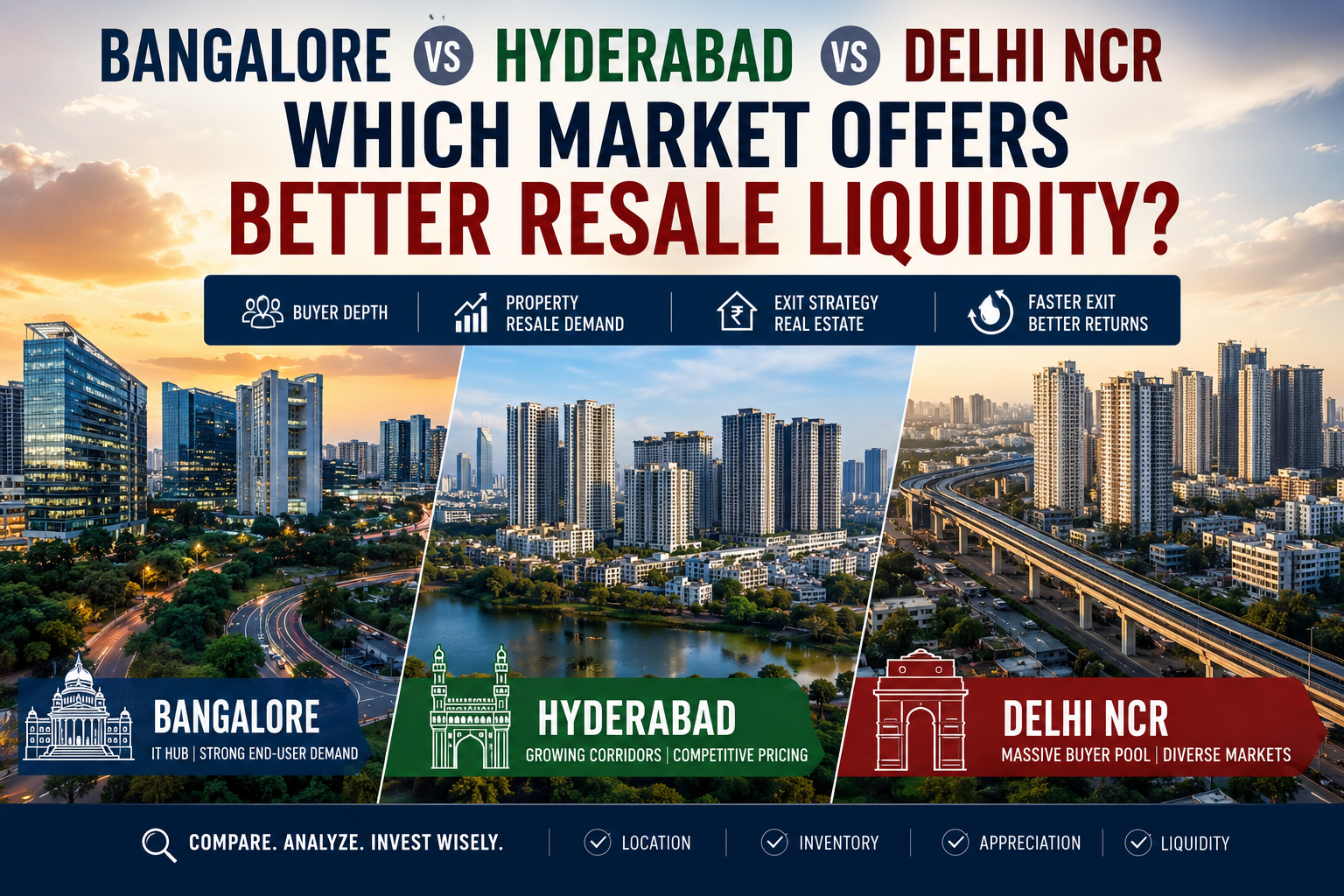
Buying a residential property is only half of a successful real estate investment. The other half is knowing how easily you can exit when your financial goals, family needs, or market conditions change. This is where resale liquidity Bangalore Hyderabad Delhi NCR becomes an important consideration for both end-users and property investors.
*Price and availability are accurate at the time of publishing. Verified by Property Specialists.
Resale liquidity refers to the ease with which a property can be sold in the secondary market at a reasonable price and within a practical time frame. A city may deliver excellent capital appreciation, but if there are too few buyers at the time of resale, the owner may have to wait longer or offer a substantial discount.
Bangalore, Hyderabad, and Delhi NCR are among India’s most active residential markets, yet their resale characteristics are very different. Bangalore is supported by technology-sector employment and a large end-user population. Hyderabad combines relatively competitive ticket sizes with rapidly expanding western employment corridors. Delhi NCR, meanwhile, has a massive and diverse buyer pool spread across Gurgaon, Noida, Greater Noida, Ghaziabad, Faridabad and emerging infrastructure corridors.
Recent market data also shows that liquidity should not be judged only by price appreciation. ANAROCK’s 2025 annual residential report recorded approximately 62,200 residential sales in Bengaluru, 57,200 in NCR and 44,900 in Hyderabad. Inventory overhang stood at around 13 months in Bengaluru, 19 months in NCR and 26 months in Hyderabad, highlighting significant differences in the pace at which available housing stock can theoretically be absorbed.
For buyers comparing resale liquidity Bangalore Hyderabad Delhi NCR, the most important questions are:
How large is the genuine end-user buyer pool?
Which micro-markets have sustained housing demand?
How much competing inventory exists?
Is the property located near employment centres?
Is the developer recognised by secondary-market buyers?
Is the configuration easy to resell?
Is the asking price realistic compared with new launches?
How long could an owner realistically take to exit?
This guide compares Bangalore, Hyderabad and Delhi NCR from the perspective of property resale demand, buyer depth, resale apartments, inventory absorption and long-term real estate exit strategy.
1. What Determines Resale Liquidity in Residential Real Estate?
Before comparing cities, it is important to understand what actually creates resale liquidity.
A liquid residential property is not necessarily the property that has appreciated the most. It is one that attracts enough qualified buyers at the prevailing market price.
For example, an apartment purchased for ₹1.5 crore that rises theoretically to ₹2 crore may look like an excellent investment. But if only a handful of buyers are willing to pay ₹2 crore, the effective resale value could be much lower.
Buyer depth measures how many potential buyers exist within a property’s ticket-size and location category.
A ₹1.5 crore apartment near a major technology corridor may attract:
IT professionals
senior corporate employees
families upgrading from smaller homes
investors
NRIs
tenants converting into homeowners
In contrast, a ₹7 crore luxury residence may depend on a significantly smaller audience even if the project is highly desirable.
Employment-Led Housing Demand
Employment hubs are among the strongest drivers of property resale demand.
Bangalore benefits from technology clusters around areas such as:
Whitefield
Outer Ring Road
Bellandur
Sarjapur Road
Electronic City
Hebbal
Manyata Tech Park
North Bangalore
Hyderabad’s resale ecosystem is heavily influenced by:
HITEC City
Financial District
Gachibowli
Kokapet
Nanakramguda
Raidurg
Kondapur
Delhi NCR has multiple employment engines rather than one dominant corridor:
Cyber City
Golf Course Road
Golf Course Extension Road
Dwarka Expressway
Noida Expressway
Sector 62 Noida
Greater Noida
industrial and corporate belts across NCR
Inventory Overhang
Inventory overhang estimates how long unsold stock could take to clear at the current sales pace.
ANAROCK reported the following for 2025:
Market
Residential Sales
Inventory Overhang
Bengaluru
~62,200 units
~13 months
Delhi NCR
~57,200 units
~19 months
Hyderabad
~44,900 units
~26 months
Lower inventory overhang can suggest stronger absorption, although resale properties compete not only with other resale homes but also with new launches.
Developer Reputation
Projects from recognised developers can have stronger liquidity because buyers may perceive lower execution, quality and documentation risk.
Projects associated with developers such as Prestige, Godrej Properties, Sobha, Brigade, Assetz, Embassy, Puravankara, DLF, M3M, Prestige Group, Mahagun and established Hyderabad builders can benefit from greater brand recall.
For investors building an exit strategy real estate plan, the most liquid property usually combines:
mainstream configuration
strong location
credible developer
reasonable ticket size
completed social infrastructure
healthy rental demand
limited nearby oversupply
Therefore, city-level comparisons are useful, but individual project selection ultimately determines resale performance.
2. Bangalore Resale Liquidity: Strong End-User Demand and Employment Depth
Among the three markets, Bangalore generally offers one of the most structurally balanced resale environments because employment generation and residential demand are closely connected.
The city has evolved beyond a single IT corridor. Technology parks, Global Capability Centres, startups, aerospace businesses, research institutions and corporate campuses are now distributed across east, southeast, north and parts of south Bangalore.
For buyers researching Bangalore residential projects, liquidity should therefore be evaluated at the micro-market level rather than merely based on the citywide average.
ANAROCK reported approximately 62,200 residential sales in Bengaluru during 2025, with inventory overhang at about 13 months—the lowest among Bangalore, Hyderabad and NCR in the same dataset.
However, Q1 2026 also saw available Bengaluru inventory rise sharply to approximately 72,800 units, up 24% year over year, as developers accelerated launches in response to strong demand.
This means the resale liquidity Bangalore Hyderabad Delhi NCR comparison cannot assume that Bangalore properties will automatically sell quickly. Increasing new supply can create significant competition for resale owners.
Bangalore Micro-Markets With Strong Resale Potential
Whitefield
Whitefield has one of the deepest end-user pools because of established technology employment, schools, hospitals, malls and metro connectivity.
Projects such as Sobha OneWorld and other branded developments across Greater Whitefield can benefit from continued demand from technology professionals.
Sarjapur Road
Sarjapur Road benefits from proximity to multiple employment corridors, including ORR, Bellandur, Electronic City and southeast Bangalore technology clusters.
Projects including Godrej developments along the Sarjapur corridor attract buyers seeking larger residential communities and access to employment centres.
North Bangalore
Hebbal, Thanisandra, Yelahanka, Devanahalli and airport-oriented corridors have become major investment zones.
Examples include:
Ramky Codename Club Class in Thanisandra
Godrej Aveline in Yelahanka
Embassy developments in North Bangalore
Birla Trimaya phases
plotted communities around Devanahalli and Doddaballapur
The resale market here could strengthen as commercial development and infrastructure mature, although investors should distinguish established residential pockets from speculative peripheral locations.
Bangalore’s Main Liquidity Advantages
Large salaried professional population
Strong rental demand
Multiple employment corridors
Consistent migration into the city
High acceptance of apartment living
Large market for 2 and 3 BHK resale apartments
Strong demand for branded gated communities
Key Risks
Bangalore investors should monitor:
launch-heavy corridors
traffic and accessibility issues
water infrastructure
high initial launch premiums
oversupply of similar apartment formats
aggressive investor pricing
The best exit strategy real estate approach in Bangalore is usually to choose mainstream configurations within established or rapidly maturing employment corridors instead of relying purely on speculative appreciation.
3. Hyderabad Resale Liquidity: Competitive Pricing but Higher Supply Sensitivity
Hyderabad has transformed dramatically over the past decade. Western Hyderabad in particular has become one of India’s most important technology and corporate real estate corridors.
Areas such as Gachibowli, Financial District, Kokapet, Neopolis, Narsingi, Kondapur, Puppalguda and Tellapur have attracted substantial residential development.
Yet the resale liquidity Bangalore Hyderabad Delhi NCR comparison reveals an important distinction: Hyderabad combines strong economic fundamentals with comparatively larger inventory overhang.
ANAROCK’s 2025 annual data placed Hyderabad’s inventory overhang at approximately 26 months versus around 13 months in Bengaluru and 19 months in NCR. Residential sales stood at roughly 44,900 units.
In Q1 2026, Hyderabad’s available inventory reached approximately 103,000 units after rising around 5% year over year.
For resale investors, this matters because a resale apartment may compete against:
unsold developer inventory
new launches
pre-launch opportunities
investor resale stock
projects offering flexible payment plans
Hyderabad’s Strongest Resale Corridors
Kokapet and Neopolis
These locations benefit from premium positioning near Financial District and the Outer Ring Road.
However, investors must recognise that high-rise luxury supply has increased significantly. Liquidity can therefore vary sharply between projects.
A high-quality project with a strong developer and superior layout may attract buyers quickly, while a similar apartment in a heavily supplied project could face greater pricing pressure.
Kondapur
Kondapur benefits from established social infrastructure and proximity to HITEC City.
Projects such as Raghava Halo and Auro Sapphire represent the type of premium high-rise development becoming more prominent across the corridor.
Because Kondapur is comparatively mature, resale demand may be broader than in completely new peripheral locations.
KPHB and Established Western Hyderabad
Projects such as Godrej Brooklyn Avenue demonstrate increasing branded developer interest in established residential areas.
Established neighbourhoods can offer stronger resale liquidity because buyers are not waiting for future infrastructure to materialise.
Hyderabad’s Liquidity Advantages
Major technology employment ecosystem
Strong Financial District expansion
ORR connectivity
Competitive price-to-space ratios compared with several other metros
Growing branded housing supply
Large premium apartment market
Hyderabad’s Main Resale Challenge
Supply is perhaps the biggest variable.
The Q3 2025 ANAROCK inventory segmentation showed that Hyderabad’s available stock was concentrated significantly in higher-value categories, with approximately 46% in the ₹80 lakh–₹1.5 crore range and a considerable share in luxury and ultra-luxury segments.
Consequently, investors targeting property resale demand should avoid assuming that every premium high-rise apartment will automatically attract strong secondary-market interest.
For better liquidity, buyers should prioritise:
completed or near-completed infrastructure
employment proximity
recognised developers
differentiated projects
rational entry pricing
practical configurations
Hyderabad can deliver attractive appreciation, but entry valuation becomes especially important when planning a future resale.
4. Delhi NCR Resale Liquidity: Massive Buyer Pool but Highly Segmented Markets
Delhi NCR is fundamentally different from Bangalore and Hyderabad because it is not one homogeneous residential market.
ANAROCK reported approximately 57,200 housing sales in NCR during 2025 with inventory overhang of around 19 months. Average capital values were reported at approximately ₹9,300 per sq. ft. during the year.
Luxury housing has also become a major NCR demand driver. CBRE reported that Delhi NCR accounted for roughly 4,000 luxury housing sales during the first half of 2025, representing about 57% of luxury sales across the top seven markets covered by its report.
This highlights an unusual characteristic of NCR: extremely deep demand can exist even at high ticket sizes when the location, developer and product positioning align.
Buyers researching Delhi NCR upcoming projects should therefore distinguish true end-user corridors from speculation-driven markets.
Corporate employment, multinational offices and a large affluent population create buyer depth.
However, ticket sizes can be extremely high, reducing the absolute number of potential buyers for luxury properties.
Noida
Noida offers a broader range of ticket sizes.
Strong resale locations include:
Noida Expressway
central Noida sectors
established sectors near employment districts
selected new infrastructure corridors
Projects such as Smartworld Elie Saab Sector 98 illustrate how ultra-luxury products are entering the Noida market.
Greater Noida and Ghaziabad
Projects such as Eldeco 7 Peaks, Eldeco Sigma developments, Prestige City Mayflower in Indirapuram and Gaur NYC Residences in Wave City demonstrate the diversity of NCR’s housing ecosystem.
These markets may attract:
first-time homebuyers
larger-family buyers
upgrade buyers
investors
professionals priced out of central Noida or Gurgaon
NCR’s Liquidity Strengths
India’s largest integrated urban residential region
enormous population base
wide ticket-size spectrum
strong infrastructure development
multiple employment centres
substantial luxury buyer pool
growing branded developer presence
NCR’s Main Risks
Liquidity can deteriorate quickly in projects with:
legal uncertainty
delayed possession
poor maintenance
weak developer reputation
excessive investor ownership
limited occupancy
unrealistic asking prices
Therefore, NCR can offer exceptionally strong resale liquidity in established projects but weak liquidity only a few kilometres away.
Micro-market selection is critical.
5. Bangalore vs Hyderabad vs Delhi NCR: Direct Resale Liquidity Comparison
The most useful way to analyse resale liquidity Bangalore Hyderabad Delhi NCR is through multiple factors rather than attempting to crown one universal winner.
City-Level Comparison
Factor
Bangalore
Hyderabad
Delhi NCR
End-user buyer depth
Very Strong
Strong
Very Strong
Employment-led demand
Very Strong
Very Strong
Strong to Very Strong
2025 inventory overhang*
~13 months
~26 months
~19 months
Main resale strength
IT-driven demand
Value + tech corridor growth
Massive diversified buyer base
Market concentration
Multiple tech corridors
Western corridor dominant
Highly fragmented
Premium buyer depth
Strong
Growing
Very Strong
Supply competition
Increasing
High in some western corridors
Highly location-specific
Rental support
Strong
Strong
Strong in major employment zones
Entry-price sensitivity
Moderate
High
Very High
Resale predictability
Relatively strong in established corridors
Project-dependent
Extremely micro-market-dependent
*Based on ANAROCK 2025 annual residential market data.
Bangalore: Best for Employment-Led Consistency
Bangalore performs well when buyers prioritise:
stable end-user demand
technology employment
rental liquidity
mainstream apartment configurations
long-term population growth
The city’s 13-month inventory overhang in 2025 was materially below Hyderabad and NCR, supporting the argument for stronger overall absorption.
However, rising launches mean investors need to avoid paying excessive premiums.
Hyderabad: Attractive Entry Economics, but Supply Must Be Watched
Hyderabad can be compelling for investors seeking:
newer residential stock
large apartments
western IT corridor exposure
modern high-rise communities
potentially attractive entry valuations
However, inventory overhang suggests owners may face stronger competition when reselling, particularly where multiple developers are launching similar inventory.
Delhi NCR: Greatest Range of Opportunities
NCR probably has the greatest variation.
A property in an occupied premium Gurgaon project may have excellent property resale demand, while a speculative apartment in a distant developing corridor could take substantially longer to sell.
Similarly, completed Noida projects near employment and infrastructure can command meaningful secondary demand.
Therefore, NCR should be treated as multiple markets rather than one.
Overall Resale Liquidity Ranking
For a typical mainstream residential investment rather than an ultra-luxury or speculative purchase, the comparison can broadly be viewed as:
Bangalore — strongest consistency
Delhi NCR — strongest market depth but larger project-level variation
Hyderabad — strong fundamentals but greater supply sensitivity
This ranking is not absolute. An excellent Gurgaon or Noida property could be more liquid than many Bangalore apartments, while a well-positioned Kokapet or Kondapur project could outperform weaker Bangalore micro-markets.
6. How Investors Should Build an Exit Strategy Before Buying
A good exit strategy real estate plan should be created before purchasing the property—not when the owner suddenly needs to sell.
Buyers comparing resale liquidity Bangalore Hyderabad Delhi NCR should evaluate their potential exit from the perspective of the next buyer.
Ask one simple question:
Why would somebody buy my resale property instead of purchasing a new launch nearby?
If there is no convincing answer, future liquidity may be limited.
Choose the Right Ticket Size
Liquidity normally improves when the property remains accessible to a broad buyer pool.
For instance:
₹1–2 crore properties may have a substantially larger audience than ₹5–8 crore properties.
2 and 3 BHK configurations usually appeal to more households.
Extremely large apartments may depend on niche buyers.
Prioritise Completed Ecosystems
A resale buyer generally values certainty.
Established projects offer visible:
construction quality
maintenance standards
neighbourhood development
resident profile
clubhouse condition
traffic patterns
water availability
rental demand
This can make mature projects easier to evaluate than early-stage launches.
Avoid Excessive Investor Concentration
Projects dominated by investors can create heavy resale competition at possession.
If dozens of owners list similar apartments simultaneously, buyers gain substantial negotiating power.
Evaluate Rental Yield and Tenant Demand
Strong tenant demand can support resale liquidity because investors may purchase tenanted or rentable properties.
Employment-oriented markets such as Whitefield, Bellandur, Gurgaon, Noida Expressway, Gachibowli and Financial District generally benefit from this relationship.
Review the Developer’s Secondary-Market Reputation
A well-maintained project from a respected developer may retain buyer confidence years after launch.
Potential buyers often compare:
construction quality
maintenance charges
common-area upkeep
association management
project density
open space
parking
clubhouse quality
developer track record
Five-Step Resale Checklist
Before buying, estimate:
Who will buy this home from me?
What competing projects will exist when I sell?
Will the neighbourhood be occupied and functional?
Will my configuration still match mainstream demand?
Can I price the property competitively and still meet my return target?
For investors, this framework is more reliable than buying solely based on projected appreciation.
FAQs: Resale Liquidity in Bangalore, Hyderabad and Delhi NCR
1. Which city has the best resale liquidity: Bangalore, Hyderabad or Delhi NCR?
Bangalore currently offers one of the most consistent combinations of employment-driven demand, rental activity and relatively efficient housing absorption. ANAROCK’s 2025 report placed Bengaluru’s inventory overhang at around 13 months compared with approximately 19 months in NCR and 26 months in Hyderabad. However, individual projects and micro-markets can perform very differently, so citywide statistics should not replace project-level analysis.
2. Is Bangalore good for resale property investment?
Yes, particularly in established employment-driven locations such as Whitefield, Sarjapur Road, Bellandur, Hebbal and Thanisandra. Bangalore’s technology workforce, migration and rental demand support resale apartments. Buyers should nevertheless avoid projects with excessive launch pricing or too much competing supply.
3. Is Hyderabad property easy to resell?
Well-located Hyderabad properties can have strong resale demand, particularly around Gachibowli, Financial District, Kondapur, Kokapet and established western neighbourhoods. However, Hyderabad currently carries substantial available inventory, so project differentiation and entry valuation are important when planning an exit.
4. Which Delhi NCR locations have strong property resale demand?
Established parts of Gurgaon, Golf Course Extension Road, Dwarka Expressway, central Noida, Noida Expressway and mature Ghaziabad neighbourhoods can offer healthy buyer depth. Liquidity varies considerably between projects, making legal clarity, occupancy, maintenance and developer credibility especially important.
5. Does higher property appreciation always mean better resale liquidity?
No. Appreciation and liquidity are different. A property may show high quoted appreciation but still take months to sell if the asking price exceeds what actual buyers are willing to pay. True liquidity depends on buyer depth, affordability, competing inventory and transaction activity.
6. What type of apartment generally has the highest resale liquidity?
Mainstream 2 and 3 BHK apartments in established or employment-linked locations generally attract the broadest buyer audience. Properties from recognised developers with functional layouts, good maintenance, adequate parking, strong rental demand and sensible ticket sizes usually enjoy better resale prospects.
Conclusion: Which Market Offers the Better Exit Opportunity?
The resale liquidity Bangalore Hyderabad Delhi NCR comparison shows that no city wins every category.
Bangalore offers arguably the strongest combination of employment-led housing demand, rental depth and relatively efficient inventory absorption. It can therefore be particularly suitable for buyers who prioritise predictable end-user demand.
Delhi NCR provides the deepest and most diverse residential ecosystem. Gurgaon and Noida can deliver excellent liquidity, while developing peripheral areas require much more careful project selection. NCR’s greatest strength is its enormous buyer base; its biggest weakness is inconsistency between neighbouring micro-markets.
Hyderabad remains a compelling long-term residential market because of its expanding technology and corporate ecosystem, modern infrastructure and relatively competitive housing options. However, investors must monitor supply carefully, particularly across premium western corridors.
The practical lesson is simple: do not choose a property solely because a city is appreciating quickly. Choose a property that the next buyer will also want.
For stronger resale potential, prioritise:
employment proximity
credible developers
established infrastructure
mainstream configurations
realistic ticket sizes
active rental demand
good project occupancy
limited competing inventory
transparent legal documentation
disciplined entry pricing
Ultimately, the best exit strategy real estate investment is a property that combines appreciation potential with genuine buyer depth. Whether that opportunity appears in Bangalore, Hyderabad or Delhi NCR depends far more on the individual micro-market, developer, configuration and purchase price than on the city name alone.

 By Upcoming Property