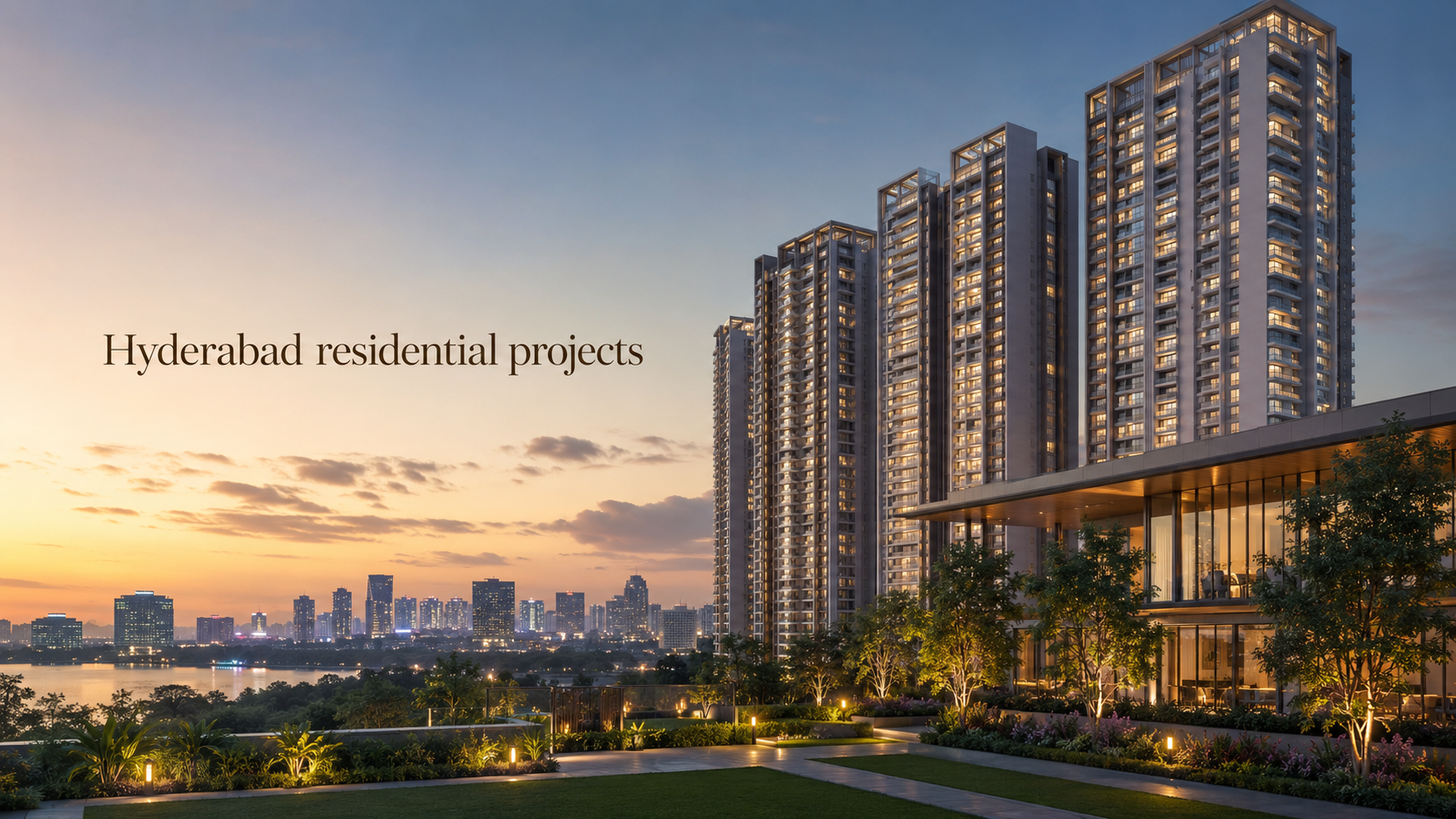
Jubilee Hills has long been one of Hyderabad’s most recognised premium residential neighbourhoods. Known for its established homes, independent villas, tree-lined roads, entertainment destinations, and high-value real estate, the locality occupies a distinctive position within the city’s property market.
*Price and availability are accurate at the time of publishing. Verified by Property Specialists.
But the residential landscape is changing.
Alongside established independent properties, new apartment developments are introducing larger luxury residences, high-rise living, exclusive community facilities, and modern residential architecture.
For homebuyers, this raises an important question: how much new housing supply is coming to Jubilee Hills between 2026 and 2030?
The answer requires more careful analysis than simply counting advertisements for new projects.
Jubilee Hills has a combination of established residential areas, redevelopment opportunities, boutique apartment developments, and larger projects marketed under the wider Jubilee Hills–Shaikpet address.
Some properties have already been launched but are still under construction. Others are approaching their expected completion dates. Additional proposals may emerge before 2030, but they should not be counted as confirmed residential supply without reliable documentation.
The wider Hyderabad housing market is also experiencing significant new development.
According to ANAROCK’s Q3 2026 residential market research, approximately 18,950 residential units were launched across Hyderabad during the quarter. West Hyderabad accounted for around 67% of those launches.
However, this does not mean that 67% of new homes are located within Jubilee Hills. West Hyderabad includes several larger residential development corridors.
Buyers researching projects in Jubilee Hills should therefore distinguish between supply within the established locality and projects marketed across neighbouring areas.
1. What Counts as New Housing Supply in Jubilee Hills?
Before estimating residential supply, it is important to understand what the term means.
Not every property advertised as new represents a home that has recently entered the market.
A project launched several years ago may still have apartments under construction in 2026. Similarly, a completed development may continue advertising unsold inventory.
Both properties can appear in searches for new apartments, but they represent different categories of housing supply.
Five important categories
Supply Category
Meaning
Buyer Consideration
Newly launched apartments
Homes entering the primary sales market
Verify registration and launch details
Under-construction apartments
Previously launched homes being developed
Check construction progress
Future completions
Homes expected to become ready for occupation
Verify completion and possession schedules
Redevelopment projects
Existing sites being rebuilt or intensified
Check permissions and ownership
Proposed projects
Concepts without established final approvals
Do not treat as confirmed supply
Why this distinction matters
Suppose a developer launched 100 apartments in 2023 with an expected completion in 2028.
Those 100 apartments form part of the future delivery pipeline.
However, they should not be counted again as 100 newly launched homes in 2028.
Likewise, if 60 of the 100 apartments have already been sold, that does not mean all 100 remain available to new buyers.
Three measurements buyers should track
New launches: The number of residential units introduced for sale during a particular period.
Upcoming completions: The number of homes in projects expected to reach completion or possession.
Unsold inventory: The number of apartments still available for purchase at a given time.
These measurements answer different questions.
For a buyer planning to move in during 2028, upcoming completions may be particularly important.
For someone searching for a wider choice of floor plans, new launches and available inventory may matter more.
For a property investor, the future completion pipeline can influence competing rental supply.
Understanding these differences is essential before drawing conclusions about the Jubilee Hills housing market.
2. How Many Residential Units Can Currently Be Identified in the Jubilee Hills Pipeline?
A complete official, locality-specific total for all residential units expected to be delivered in Jubilee Hills from 2026 to 2030 has not been established through the available published information.
However, several identifiable developments provide a useful starting point.
Four documented projects in the Jubilee Hills–Shaikpet catchment represent approximately 673 planned residential homes.
Identifiable residential developments
Project
Planned Homes
RERA Reference
Published Completion Information
The World at Jubilee Hills
478 residential units
P02500004638
September 2028 in updated RERA record
Vamsiram The Niche
96 apartments
P02500006592
December 2028 originally; April 2029 with reported special extension
Realplus Fuji Halcyon
75 residences
P02500005860
Late 2028 in property listings
Phoenix Everest
24 apartments
P02500004327
March 2028
Documented sample
673 homes
The figures describe planned residential units, not unsold inventory. Completion dates are published or regulatory references rather than guaranteed handover dates. Buyers should check current records before booking.
Why the number 673 matters
This sample illustrates the variety of residential development occurring in the Jubilee Hills area.
The projects range from a relatively large luxury residential community to smaller exclusive developments with fewer than 100 apartments.
However, 673 is not the total housing supply forecast for Jubilee Hills.
Other registered developments, individual apartment buildings, redevelopment schemes, and future launches may contribute additional units.
What does the sample reveal?
The identified projects offer a mixture of residential formats:
Large luxury apartments.
Exclusive 4 and 5 BHK residences.
Smaller residential communities.
High-rise developments.
Boutique apartment projects.
Homes targeting premium and ultra-premium buyers.
This suggests that a meaningful portion of the identifiable pipeline is concentrated in larger, higher-value apartment formats.
It does not establish that every new residence in Jubilee Hills will be a luxury apartment.
Smaller registered and redevelopment projects may serve different buyer segments.
Why official verification remains essential
Unit counts can change following approved revisions.
Possession schedules may also be modified in accordance with applicable procedures.
Buyers should therefore verify the latest registered project details instead of treating a property-listing table as a permanent record.
3. Why Jubilee Hills Has a Different Supply Pattern From Expanding Suburbs
Jubilee Hills is an established residential neighbourhood rather than a newly planned peripheral residential township.
This distinction influences the kinds of new homes that can enter the market.
In large expansion corridors, developers may acquire substantial land parcels and construct thousands of apartments across multiple towers.
In established neighbourhoods, development opportunities can be more dependent on individual sites, redevelopment, and the availability of suitable land.
Characteristics of established residential markets
Important features can include:
Existing residential buildings.
Independent houses and villas.
Smaller development parcels.
Established internal roads.
Mature neighbourhood services.
Commercial and residential mixed activity.
Site-specific planning constraints.
How these factors affect housing supply
A developer cannot assume that every available site can accommodate a large residential tower.
The permitted development depends on land use, access roads, building regulations, approvals, and other relevant conditions.
Consequently, new supply may arrive through a combination of small apartment buildings and selected larger projects.
Redevelopment can introduce modern apartments on sites previously occupied by older residential structures.
For example, replacing an ageing residential building with a new approved development may create additional homes.
However, the actual increase depends on the original number of units and the sanctioned redevelopment proposal.
Not every redevelopment adds substantial housing supply.
Some may replace a single luxury house with a limited number of larger apartments.
Why this matters for buyers
Buyers should distinguish a premium address from a promise of limited future competition.
An established neighbourhood may have fewer obvious large vacant sites, but future residential opportunities can still emerge through redevelopment and changing land ownership.
Similarly, nearby Shaikpet and Film Nagar developments may compete for buyers seeking a Jubilee Hills lifestyle.
The correct supply analysis should therefore include both the established locality and relevant neighbouring projects while keeping their geographic identities clear.
The period from 2026 to 2030 should be evaluated as a sequence of regulatory, construction, and market milestones rather than as a guaranteed annual delivery schedule.
A project with an expected completion date in a particular year may be delivered earlier or later.
A development announced in one year may also enter the market only after the required approvals and registration are obtained.
Year-by-year buyer watchlist
Year
Key Supply Question
What Buyers Should Monitor
2026
What is already registered and under construction?
Current project filings, approvals and construction updates
2027
Which projects are progressing towards completion?
Physical progress, revised schedules and new registrations
2028
Which identified luxury developments reach their stated completion periods?
The World, Fuji Halcyon, Phoenix Everest and other relevant projects
2029
Which extended or later-stage projects become ready?
The Niche, project revisions and actual occupancy approvals
2030
What additional housing has been launched or completed?
New registrations, redevelopment and completed stock
2026: Establish the baseline
For buyers entering the market in November 2026, the immediate priority is identifying existing registered supply.
A useful shortlist should contain the current RERA registration, number of homes, apartment configurations, construction stage, and expected completion date.
The list should separate already sold units from apartments still available.
2027: Watch construction and approvals
During 2027, buyers should monitor whether construction is progressing according to disclosed schedules.
Updated building permissions, completion targets, and developer filings can materially change the expected supply picture.
2028: Track potential completions
Several identifiable premium projects have published completion periods around 2028.
This could introduce additional completed luxury housing to the Jubilee Hills–Shaikpet catchment.
However, a published completion date does not prove that a project will be legally ready for occupation during that year.
2029: Review delayed and extended timelines
Some projects may have completion periods extending into 2029.
Buyers should review whether an extension has been recorded and what the latest contractual possession date provides.
2030: Reassess the market
By 2030, additional projects may have been approved, launched, or completed.
However, no reliable total number of new Jubilee Hills homes for 2030 can be stated from the current evidence.
A useful forecast should be updated as new registrations and construction milestones become available.
5. The World at Jubilee Hills: A Major Identifiable Source of New Luxury Housing
Among the larger developments associated with the Jubilee Hills–Film Nagar area is The World at Jubilee Hills.
The project is registered under Telangana RERA number P02500004638, with DSR SR Prime Spaces LLP as the promoter.
The latest available project documentation describes 478 residential dwellings, along with separate amenity-related building entries.
Why the project is important to the supply discussion
Compared with smaller boutique developments, a residential community containing several hundred large apartments can make a more substantial contribution to the local luxury housing pipeline.
Its scale is therefore relevant when assessing future housing availability.
What does the project offer?
Its registered configuration information includes:
4 BHK residences.
5 BHK residences.
Duplex apartments.
Multiple residential buildings.
Shared amenity infrastructure.
The project is positioned within the ultra-luxury residential segment.
What do the regulatory records indicate?
The latest accessible RERA project information records a completion date in September 2028 following a reported four-month special extension.
The project has also published construction updates.
A CRISIL Ratings report dated August 2026 identified physical project progress of approximately 45% at the relevant reporting date and discussed remaining execution and funding requirements.
This demonstrates why buyers should examine both sales progress and physical construction.
Does a high booking percentage mean the project is complete?
No.
A project may have sold a substantial portion of its apartments while construction continues.
Bookings indicate commercial demand; they do not establish building readiness.
What should buyers monitor?
Current construction progress.
Tower-specific completion.
Updated RERA disclosures.
Approved revisions.
Occupancy-related documentation.
Actual apartment availability.
Contractual possession arrangements.
Large projects can influence the local supply picture, but their unit counts should be interpreted alongside delivery progress and available inventory.
6. Boutique Luxury Projects: Why Smaller Unit Counts Still Matter
Not every meaningful addition to Jubilee Hills housing supply comes from a development with hundreds of apartments.
Smaller projects can play an important role in the premium market.
For buyers prioritising privacy, limited residential density, or large apartment layouts, a boutique development may offer a different proposition from a larger community.
Vamsiram The Niche
The Niche is associated with the Jubilee Hills–Shaikpet area.
Published project information identifies approximately 96 four-bedroom apartments, with marketed sizes around 3,666–3,942 square feet.
The project’s registration reference is P02500006592.
Its original registered completion date was December 2028, while an updated data record reports a four-month extension into April 2029.
The developer’s promotional materials have also carried different possession messaging.
Buyers should therefore verify the latest regulatory and contractual position rather than relying on a single advertised date.
Realplus Fuji Halcyon
Fuji Halcyon is marketed as a boutique luxury development with 75 residences in Jubilee Hills.
The developer identifies registration number P02500005860 and promotes large four- and five-bedroom homes.
Published property information places its expected possession period around late 2028.
Its relatively small unit count illustrates how premium new supply may be concentrated in large-format residences rather than high-volume apartment inventory.
Phoenix Everest
Phoenix Everest is another smaller residential development in Jubilee Hills.
Published project information identifies 24 apartments, with registration number P02500004327 and a completion period around March 2028.
How boutique supply differs from mass-market supply
Factor
Boutique Luxury Projects
Larger Residential Communities
Unit count
Relatively limited
Often higher
Apartment formats
Frequently larger
May offer more configurations
Privacy
May provide fewer neighbouring households
Depends on layout
Shared amenities
Project-specific
May be more extensive
Maintenance
Depends on cost-sharing structure
Spread across more residences
Resale buyer pool
Often narrower at high price points
Depends on product mix
Local supply contribution
Smaller numerical addition
Larger numerical addition
Why this matters for market analysis
A development with only 24 apartments can introduce substantial residential floor area without adding many separate homes.
Therefore, analysts should consider both the number of residential units and the size of those units.
For luxury buyers, the quality and configuration of supply may matter as much as the total apartment count.
7. How Much New Supply Is Coming Across Hyderabad, and Why Does It Matter?
Jubilee Hills does not operate independently of the wider Hyderabad residential market.
Buyers considering premium property within the locality may also evaluate nearby or competing developments across western Hyderabad.
Citywide launch activity can therefore influence buyer choice, developer pricing, and resale competition.
Hyderabad’s Q3 2026 market snapshot
According to ANAROCK’s residential market research:
Market Indicator
Q3 2026
New residential launches
Approximately 18,950 units
Residential sales
Approximately 12,950 units
Available housing inventory
Approximately 114,700 units
West Hyderabad share of launches
Approximately 67%
West Hyderabad share of sales
Approximately 61%
West Hyderabad share of available inventory
Approximately 66%
These figures cover Hyderabad and its broader residential market zones, not Jubilee Hills alone.
What does the launch figure indicate?
The city is adding substantial new residential stock.
However, newly launched apartments are spread across multiple locations and price segments.
West Hyderabad includes areas with very different development conditions and housing formats.
Why broader market supply matters
A buyer seeking a large four-bedroom apartment may compare Jubilee Hills with luxury developments in Gachibowli, Raidurg, Kokapet, or other western localities.
These competing projects can influence purchasing decisions even if they do not add a single apartment to Jubilee Hills itself.
Can higher supply affect pricing?
Additional supply can expand buyer choice, but it does not automatically cause prices to decline.
Pricing depends on demand, location, apartment quality, available inventory, construction stage, and financing conditions.
The difference between citywide and micro-market figures
A citywide average cannot establish the exact price or future supply of Jubilee Hills.
Similarly, a West Hyderabad housing statistic should never be presented as a direct measure of Jubilee Hills launches.
The most useful decision comes from comparing similar properties within a realistic buyer shortlist.
8. Will Redevelopment Add More Apartments to Jubilee Hills by 2030?
Redevelopment is an important category to monitor in an established premium neighbourhood.
However, it is difficult to forecast how many additional homes redevelopment will produce without detailed project-level approval data.
What does redevelopment involve?
Redevelopment may involve replacing an existing property with a new residential building.
This can occur when an older structure is no longer suitable for the owner’s requirements or when a site is considered for a different approved residential configuration.
Does redevelopment always increase supply?
No.
Consider three hypothetical situations:
Existing Site
Approved Replacement
Net Change
1 independent house
6 apartments
+5 homes
8 older apartments
12 new apartments
+4 homes
1 luxury house
1 new luxury villa
0 homes
These are illustrative scenarios, not claims about actual approvals in Jubilee Hills.
Why redevelopment can be difficult to predict
A proposed redevelopment may depend on:
Land ownership.
Existing occupants.
Agreement among relevant parties.
Building permissions.
Road access.
Planning restrictions.
Project economics.
Financing.
Regulatory compliance.
Until the required permissions and registration are established, a proposed project should not be treated as confirmed supply.
How buyers can monitor redevelopment
Watch for approved building plans and new residential project registrations in the relevant locality.
The exact plot address matters because projects advertised as Jubilee Hills may legally fall within neighbouring revenue or municipal areas.
What about older residential buildings?
Not every ageing building will be redeveloped during the 2026–2030 period.
Buyers should avoid assuming that older properties automatically represent future apartment inventory.
The redevelopment pipeline is best treated as potential additional supply until specific projects become sufficiently documented.
9. Will More Luxury Apartments Change Prices in Jubilee Hills?
New housing supply can affect buyer choice and competition, but its influence on pricing is not straightforward.
Jubilee Hills contains different property types, including independent houses, villas, older apartments, and premium new developments.
Each may serve a different group of buyers.
Why luxury supply behaves differently
A newly launched four-bedroom apartment priced for an affluent household may not compete directly with a smaller, older apartment.
Similarly, an ultra-luxury residence with private amenities may attract buyers who would otherwise consider independent houses.
Factors influencing prices
Important considerations include:
Exact location.
Plot and road access.
Apartment configuration.
Building age.
Construction quality.
Floor level.
Views and privacy.
Maintenance obligations.
Legal documentation.
Competing inventory.
Buyer purchasing power.
Does limited supply guarantee appreciation?
No.
Even in an established premium location, property values can be influenced by market conditions, borrowing costs, and buyer demand.
A high asking price does not prove that comparable properties are achieving the same price in completed transactions.
The risk of comparing unlike properties
A low-density luxury apartment may have a higher price per square foot than a conventional residential development.
However, buyers should compare equivalent area measurements and consider the complete cost.
What investors should examine
Investors should assess rental demand, maintenance expenses, vacancy risk, and resale liquidity.
A very large luxury apartment may involve a substantial capital commitment and a relatively narrow pool of potential tenants.
Additional premium supply can provide more options to those tenants and future buyers.
Therefore, purchase decisions should be supported by realistic financial assumptions rather than guaranteed appreciation expectations.
10. How Buyers Should Evaluate New Launches in Jubilee Hills
An upcoming residential development can be attractive because it may offer contemporary architecture, newly planned amenities, and a selection of apartments.
However, buyers should examine its actual legal and construction status.
Start with RERA verification
Check the precise project registration and confirm:
Registered promoter.
Project address.
Approved apartments.
Registered land area.
Construction details.
Proposed completion date.
Relevant project documents.
Compare apartment functionality
A large advertised apartment size does not always translate into efficient internal space.
Buyers should review the actual RERA carpet area and approved floor plans.
Check water, electricity, lifts, parking, fire safety, and access to the development.
Buyer evaluation table
Verification
Why It Matters
RERA registration
Establishes registered project information
Building permissions
Confirms approved development
Carpet area
Supports comparable space analysis
Construction progress
Indicates execution status
Completion date
Helps plan relocation
Complete price
Establishes financial commitment
Common amenities
Clarifies what will be delivered
Maintenance
Shows recurring cost exposure
Parking
Confirms buyer entitlement
Location
Determines practical residential convenience
A project should not be selected solely because its marketing describes it as new, exclusive, or limited.
The decision should be based on current documents and the practical benefits of the selected apartment.
11. The 2026–2030 Buyer Strategy: When Should You Buy?
There is no single ideal purchase year for every household.
The best timing depends on the intended use of the property, financial resources, and moving requirements.
Buyers needing a home immediately
A legally ready-to-move apartment may be more suitable for households with an urgent relocation requirement.
The buyer can examine the actual building and understand the current neighbourhood environment.
Buyers planning to move in 2028
A registered development with a published 2028 completion period may be relevant.
However, the buyer should examine current construction progress and understand the contractual possession commitments.
Buyers considering 2029–2030
A longer time horizon provides flexibility to monitor new registrations and changes in inventory.
However, a future project should not be assumed to become available merely because a developer has announced an intention to launch it.
Investors seeking rental income
A completed property may allow rental marketing sooner, subject to legal readiness and market conditions.
An under-construction apartment cannot produce ordinary rental income before it becomes available for occupation.
Financial planning
Buyers should compare:
Down payment.
Loan requirements.
Existing rental commitments.
Additional purchase charges.
Interior expenses.
Recurring maintenance.
Emergency savings.
Holding period.
A practical timing comparison
Buyer Goal
Potentially Suitable Approach
Move within six months
Inspect legally ready homes
Move in 2028
Review progress of registered projects
Move in 2029
Compare projects with later delivery schedules
Purchase by 2030
Monitor registrations and actual inventory
Earn rent sooner
Examine completed property
Seek long-term residence
Prioritise layout and affordability
Buying early is not automatically better than buying later.
A sensible purchase is one that fits both the household’s timeline and its financial circumstances.
12. What Buyers Should Monitor Every Year Until 2030
A useful housing supply watchlist should be updated regularly.
Instead of treating a project list as permanent, buyers should review the information when new regulatory disclosures or construction milestones become available.
Project-level tracking
Maintain a simple record containing:
Project name.
Exact location.
RERA registration.
Total residential units.
Unsold inventory, where reliably available.
Current construction stage.
Expected completion date.
Revised completion information.
Apartment configurations.
Current price quotations.
Occupancy or completion documentation, where applicable.
Understanding supply changes
A project may remain in the pipeline while its unit count is unchanged.
If a developer sells more apartments, available inventory falls, but the total planned supply does not.
If a new project is registered, the pipeline may increase.
If a project receives the necessary completion approvals and is delivered, its units move from future supply into completed stock.
What a proper dashboard should show
Metric
Meaning
Total registered units
Planned homes in identified projects
Homes booked
Units reported sold or allotted
Available inventory
Units still offered for purchase
Under-construction units
Homes yet to reach completion
Completed units
Homes whose relevant completion status is established
New registrations
Additional project supply
Cancelled or revised units
Changes to the original pipeline
Avoid double-counting
A project should be counted once within the appropriate category.
For example, a home already registered in 2022 should not be counted as a fresh launch in 2028 simply because its expected possession falls in that year.
Accurate tracking provides a more realistic picture of how Jubilee Hills housing availability is evolving.
Frequently Asked Questions About Jubilee Hills Housing Supply
1. How much new housing supply is coming to Jubilee Hills between 2026 and 2030?
A comprehensive locality-wide total has not been established from the available published records. Four identifiable projects in the Jubilee Hills–Shaikpet catchment account for approximately 673 planned residential units, but this is a non-exhaustive sample rather than the complete pipeline.
2. Which projects are part of the identified supply pipeline?
Documented examples include The World at Jubilee Hills, Vamsiram The Niche, Realplus Fuji Halcyon, and Phoenix Everest.
3. Are all 673 apartments newly launched in 2026?
No. These homes belong to projects launched or registered across earlier years. The figure represents identified planned residential units with completion schedules relevant to the 2026–2030 period.
4. Are all 673 apartments still available for sale?
No. The total number of planned units is different from unsold inventory. Some homes may already have been booked or sold.
5. Which year has important luxury apartment completions in the identified sample?
Several projects have published completion periods around 2028. However, actual possession depends on construction progress, approvals, and individual contractual terms.
6. What is the completion timeline for The World at Jubilee Hills?
The updated accessible RERA record identifies September 2028 as the proposed completion period following a special extension. Buyers should verify the latest regulatory information.
7. How many apartments are planned at Vamsiram The Niche?
Published project information identifies 96 apartments, with four-bedroom configurations.
8. How many apartments are planned at Fuji Halcyon?
The developer markets 75 luxury residences in Jubilee Hills.
9. How many homes are planned at Phoenix Everest?
Published project information identifies 24 residential apartments.
10. Will more new apartments be launched before 2030?
Additional launches are possible, including redevelopment projects, but their number cannot be reliably forecast without documented registrations and approved plans.
11. Is Jubilee Hills housing supply limited?
Jubilee Hills is an established premium neighbourhood with a different development pattern from major expansion corridors. However, limited vacant land does not mean that no new supply can be created through redevelopment or approved projects.
12. Is Jubilee Hills the same property market as Shaikpet?
No. They are distinct geographic references, although certain projects in Shaikpet are marketed using the Jubilee Hills address or catchment. Buyers should check exact legal locations.
13. Does new housing supply automatically reduce property prices?
No. Prices depend on demand, property type, quality, location, financing, and available competing inventory. Additional supply can increase choice without guaranteeing price declines.
14. Are new Jubilee Hills apartments mainly luxury properties?
Several identifiable projects focus on premium 4 and 5 BHK residences, but this does not establish that every registered new apartment development in the locality belongs to the luxury segment.
15. Is Jubilee Hills suitable for residential investment?
It may be suitable for certain buyers, but investment performance depends on acquisition price, rental demand, operating expenses, and resale liquidity. Future appreciation is not guaranteed.
16. Should buyers consider ready-to-move apartments?
Yes. A completed apartment may suit buyers needing near-term occupation or wanting to inspect the actual home and community before purchasing.
17. How can buyers verify a project?
Buyers should examine Telangana RERA registration, sanctioned plans, registered completion details, and relevant legal documentation.
18. What is the difference between new supply and available inventory?
New supply describes homes entering the market or development pipeline, depending on the measurement. Available inventory refers to apartments that remain unsold at a particular date.
19. Will redevelopment create more apartments in Jubilee Hills?
Redevelopment may contribute additional residential units where permissions allow. However, the number of future homes depends on specific site approvals and cannot be assumed.
20. What should buyers monitor through 2030?
Track new project registrations, approved unit counts, construction progress, revised completion dates, actual handovers, available inventory, and unit-specific prices.
Conclusion: What Does the 2026–2030 Housing Pipeline Mean for Jubilee Hills Buyers?
Jubilee Hills is experiencing a gradual evolution in its residential landscape.
Alongside established independent houses and existing apartment communities, premium residential developments are introducing new high-value housing opportunities.
The identifiable pipeline includes larger developments such as The World at Jubilee Hills and smaller luxury communities such as The Niche, Fuji Halcyon, and Phoenix Everest.
Together, these four projects represent approximately 673 planned residential homes within the broader Jubilee Hills–Shaikpet catchment.
However, this number should not be mistaken for the complete local supply forecast.
Additional registered projects, redevelopment opportunities, and future launches may affect residential availability between 2026 and 2030.
The wider Hyderabad market is also adding substantial housing supply, particularly across western development corridors.
For buyers, the most important task is distinguishing between projects that are merely proposed, those that are officially registered, those under construction, and homes legally ready for occupation.
Apartment size, complete purchase cost, location, amenities, construction progress, and long-term maintenance should all be evaluated carefully.
Ultimately, the right decision depends on the buyer’s household requirements, possession timeline, and financial capacity.
Jubilee Hills may remain a desirable residential address, but the smartest buyers will focus less on how many projects are advertised and more on how many verified homes are actually being built, completed, and offered at prices that make practical sense.

 By bangaloreupcomingproject