Most homebuyers spend considerable time comparing apartment prices, floor plans, amenities and locations before booking a property. However, there is another financial consideration that deserves equal attention: the cost of maintaining the home after possession.
*Price and availability are accurate at the time of publishing. Verified by Property Specialists.
An apartment purchase involves a substantial upfront investment, but ownership expenses continue long after the sale deed is registered.
Residents pay for electricity, water, common-area maintenance, repairs and other essential services. In a large residential development, expenses may also arise from landscaped spaces, lifts, recreational facilities, security and shared infrastructure.
These costs can influence the household budget for many years.
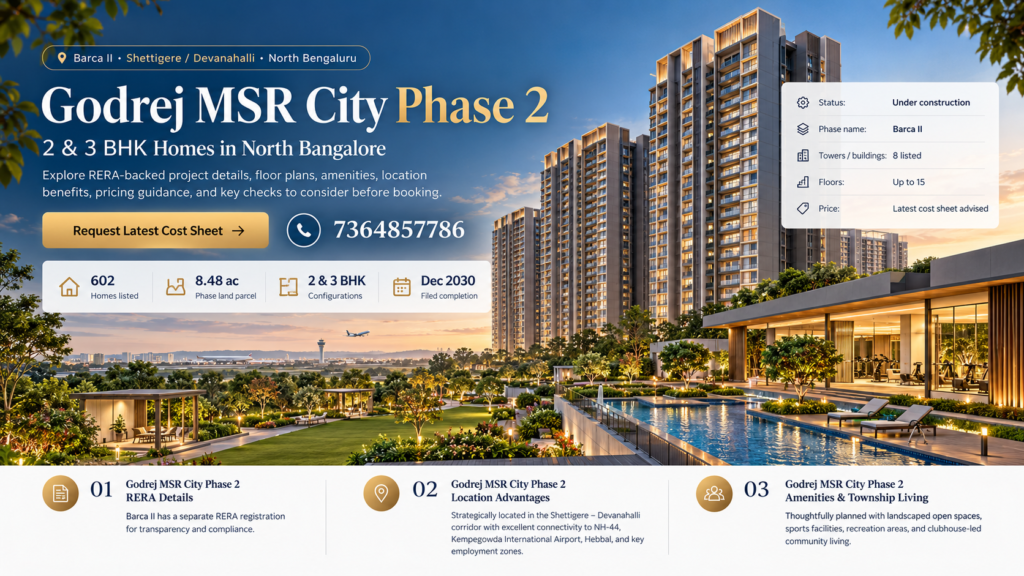
Godrej MSR City phase 2, also known as Barca II at Godrej MSR City, is an under-construction residential phase in the Shettigere–Devanahalli area of North Bengaluru.
The registered phase covers approximately 8.48 acres and comprises eight residential buildings with a total of 602 apartments. The available configurations include 2 BHK and 3 BHK residences, with the registered completion date currently listed as December 31, 2030.
For buyers considering a home here, the project offers an opportunity to live within a larger residential township associated with Godrej Properties.
However, the scale of the development also makes it important to understand how shared infrastructure and amenities may influence recurring ownership expenses.
A family purchasing a 3 BHK apartment may find the initial purchase price manageable but should also consider whether monthly maintenance, utilities, interior upkeep and future repair contributions fit comfortably within its long-term financial plans.
This guide explains the different expenses associated with apartment ownership, how maintenance budgets are generally structured and what prospective buyers should verify before planning their finances for the years following possession.
Godrej MSR City Phase 2: Project Overview
Project Detail
Current Information
Project Name
Godrej MSR City Phase 2
Registered Phase
Barca II at Godrej MSR City
Developer Association
Godrej Properties
Registered Promoter
M S Ramaiah Ventures LLP
Location
Shettigere–Devanahalli, North Bengaluru
Registered Project Area
Approximately 8.48 Acres
Residential Buildings
8
Apartments
602
Building Height
Up to Approximately 15 Floors
Configurations
2 BHK and 3 BHK
Registered Completion
December 31, 2030
RERA Number
PRM/KA/RERA/1250/303/PR/300625/007887
Current Status
Under Construction
The figures above describe the registered Barca II phase rather than the entire Godrej MSR City township.
Actual maintenance charges, common-area contributions and utility expenses should be confirmed from the applicable agreements and future operating budgets. They are not established by the project’s acreage or apartment count alone.
1. Why the Purchase Price Is Only the Beginning
When buyers compare residential properties, the most visible number is usually the apartment’s selling price.
For example, a buyer may shortlist a 2 BHK because it requires a lower initial commitment than a 3 BHK.
Another household may choose a three-bedroom apartment because it provides more space for children or visiting parents.
Both decisions are reasonable.
However, the initial price represents only one part of the long-term financial commitment.
After possession, a household may incur recurring expenses for:
Common-area maintenance
Apartment electricity
Water and utility services
Repairs and servicing
Household equipment
Insurance
Periodic replacement of fittings
The actual costs depend on the property and how the family uses it.
The Difference Between Buying Cost and Ownership Cost
The buying cost generally includes the financial commitment associated with acquiring the apartment.
The ownership cost refers to expenditure required to use, maintain and preserve it over time.
A buyer planning to live in the property for ten or fifteen years should understand both.
For example, a family may invest heavily in premium interiors immediately after possession.
However, those interiors will also require periodic cleaning, maintenance and eventual repairs.
Similarly, a large residential community may provide useful amenities but require ongoing spending to maintain them.
The objective is not to avoid these expenses.
It is to understand them before they become unexpected financial obligations.
Why This Matters for Under-Construction Properties
Godrej MSR City Phase 2 has a registered completion reference of December 2030.
As the development is still under construction, buyers should avoid assuming a particular monthly maintenance amount without a documented basis.
The appropriate approach is to prepare an estimated budget now and update it once the relevant charges and operating arrangements are formally disclosed.
2. What Does Apartment Maintenance Usually Cover?
Apartment maintenance generally refers to expenditure associated with operating and maintaining common areas and services.
The exact scope depends on the development’s legal structure, maintenance agreements and governing arrangements.
In a residential project containing hundreds of apartments, these expenses may cover several different functions.
Security Services
Residential communities may employ security personnel and operate access-management systems.
The actual arrangements depend on the approved and operational setup.
Associated expenses may include staffing, equipment servicing and related administrative costs.
Housekeeping
Common areas require routine cleaning.
This can include:
Entrance lobbies
Corridors
Lift lobbies
Other designated shared spaces
The maintenance budget may account for cleaning personnel, supplies and equipment.
Lift Maintenance
High-rise residential buildings depend on lifts for everyday movement.
Lift systems require appropriate inspection, servicing and repairs.
The final expenses depend on the equipment installed and the relevant maintenance contracts.
Landscaping
Gardens, outdoor seating areas and planted spaces require upkeep.
This may involve irrigation, gardening personnel, equipment and replacement planting.
Common-Area Electricity
Electricity may be required for:
Corridor lighting
Entrance areas
Certain building services
Recreational facilities
Other shared equipment
Actual consumption depends on the systems installed and their operating patterns.
Administrative and Operational Expenses
A residential community may also require accounting, management and other administrative functions.
The important point is that maintenance is not simply a fee collected without purpose.
It should correspond to documented expenditure and applicable obligations.
Buyers should request a clear explanation of what the maintenance amount includes.
3. How Could Maintenance Charges Be Calculated?
One of the most important questions is how recurring charges will be allocated among apartments.
Different residential communities may use different charging arrangements, subject to applicable law and governing documents.
For example, a community may allocate certain expenses according to a defined apartment area, ownership interest or another legally applicable method.
Buyers should not assume that maintenance will necessarily be calculated using super built-up area.
An Illustrative Calculation
Consider a hypothetical apartment for which a maintenance agreement defines a chargeable area of 1,200 sq. ft.
Suppose the monthly maintenance rate is calculated at three different illustrative levels.
Illustrative Rate
Monthly Charge
Annual Charge
₹4 per sq. ft.
₹4,800
₹57,600
₹5.50 per sq. ft.
₹6,600
₹79,200
₹7 per sq. ft.
₹8,400
₹1,00,800
Important: These are hypothetical calculations. They are not quoted, approved or forecast maintenance rates for Godrej MSR City Phase 2.
Such features can improve the residential experience.
However, they also involve operating responsibilities.
A gym may require equipment servicing.
A swimming pool, if included and operational, may require water treatment, cleaning and related services.
Outdoor recreational areas may need lighting and periodic repairs.
The exact facilities included in Barca II and their relationship with other township phases should be verified.
Clubhouse Operating Costs
Possible expense categories include:
Housekeeping
Equipment servicing
Electricity
Water
Repairs
Staffing
Consumable supplies
The actual expenditure depends on the approved facilities and their operating arrangements.
Should Every Resident Pay for Every Amenity?
The answer depends on the applicable maintenance and usage provisions.
Some expenses may be included in general community maintenance.
Other facilities may have separate booking or usage charges.
A resident who rarely uses the clubhouse should not assume this automatically eliminates their contribution toward common operating expenses.
Similarly, a buyer should not assume unlimited facility access simply because the project advertises a premium amenity package.
Verify Facility Delivery and Access
For a multi-phase township, this is particularly important.
Buyers should confirm:
Which amenities belong to Barca II
Which are shared with other phases
When relevant facilities are expected to be available
What cost-sharing arrangements apply
Who will operate them
A facility that is not yet operational should not be treated as though its actual maintenance expenditure is already known.
6. The Master Plan Can Reveal Future Maintenance Responsibilities
The Godrej MSR City phase 2 Master Plan should help buyers understand the proposed arrangement of the eight residential buildings and associated common spaces.
A master plan is useful for more than selecting an apartment with an attractive view.
It can also help buyers identify the physical areas that may require long-term upkeep.
Internal Roads
Paved roads and circulation areas may require periodic repairs and maintenance.
Landscaped Spaces
Gardens and planted areas need appropriate care.
Pedestrian Pathways
Walking routes may require cleaning, lighting and repair.
Recreational Areas
Outdoor facilities may require equipment upkeep and surface maintenance.
Service Infrastructure
Certain systems may be located within or beneath common areas.
Their operation can involve ongoing technical expenses.
Why the Registered Boundary Matters
Barca II is part of a wider development.
Buyers should not calculate maintenance responsibilities merely by looking at the entire township illustration.
A common facility may be within the registered phase, or it may serve several phases under a documented arrangement.
The cost allocation may differ accordingly.
The relevant governing documents should establish the applicable responsibilities.
7. Why Water Expenses Deserve Separate Attention
Water is an essential operating requirement for every residential community.
A household uses water for cooking, bathing, cleaning, washing and sanitation.
Shared spaces may require water for other purposes.
In a development containing 602 apartments, the design and operation of water-related infrastructure are important.
However, a project’s size does not establish its actual water cost.
Understand the Supply Arrangement
Buyers should ask what water sources and supply arrangements are approved for the registered phase.
The relevant documentation may address water storage, distribution and associated infrastructure.
Do not assume that a particular municipal or borewell arrangement is guaranteed without checking the official specifications.
Water Treatment and Distribution
Depending on the approved design, water-related infrastructure may require pumps, treatment equipment and ongoing servicing.
These systems can contribute to community operating expenses.
Wastewater Management
The registered project disclosures identify sewage and drainage arrangements as applicable infrastructure.
The exact systems and operating costs should be confirmed through the approved design and future maintenance budgets.
Landscaping and Water Use
Large gardens may create irrigation requirements.
The actual demand depends on the planting design, irrigation arrangements and maintenance practices.
Questions Buyers Should Ask
How is water expenditure allocated?
Are apartment-level water meters proposed?
What costs are included in maintenance?
What costs are billed separately?
How are common-area water expenses handled?
These questions help families understand whether the quoted maintenance amount covers all water-related expenditure or only selected components.
8. Electricity and Power Backup: What Will Residents Pay For?
Electricity costs can be divided into two broad categories.
Apartment Consumption
This relates to the electricity used inside the private residence.
Common-Area Consumption
This relates to electricity used by shared facilities and building services.
The actual billing arrangements depend on the approved electrical infrastructure and applicable contracts.
Apartment Electricity
Household consumption depends on factors such as:
Air-conditioning usage
Number of occupants
Appliance efficiency
Daily routines
Lighting
Working-from-home requirements
A family using multiple air conditioners for long periods may have different electricity expenses from a household relying mainly on fans and natural ventilation.
Common Electricity
Shared electricity may support relevant building systems and facilities.
Depending on the installed arrangements, this could include lifts, lighting and other common services.
Public listings show different price references depending on configuration, area and inventory.
Recent third-party listings have advertised approximately ₹1.59 Cr onwards for certain two-bedroom homes, with higher pricing for three-bedroom configurations.
These figures are indicative and should not replace a current developer quotation.
Separate Acquisition and Move-In Expenses
The purchase budget may involve:
Apartment consideration
Applicable taxes
Stamp duty
Registration expenses
Home-loan-related charges
Interior installation
Appliances
Moving services
Maintenance-related deposits or other applicable contributions may also need to be considered.
Prepare for the First Year
The first year after occupation may involve more spending than a typical later year.
A household may purchase furniture, install storage, arrange appliances and complete other essential work.
This spending should not be confused with normal annual apartment maintenance.
Avoid Using Every Available Rupee for Interiors
A premium apartment may encourage buyers to spend heavily on furnishing.
However, maintaining sufficient savings for recurring expenses and unexpected costs can be more useful than completing every decorative upgrade immediately.
A functional home can be established in stages.
The goal is comfortable ownership without unnecessary financial pressure.
13. How RERA and the Agreement Affect Maintenance Obligations
The project is registered as Barca II at Godrej MSR City, with a proposed completion date of December 31, 2030.
Before booking, buyers should review the latest official project details and applicable agreement provisions.
Maintenance Terms Should Be Understood Before Signing
A buyer should identify relevant provisions covering:
Maintenance deposits
Common-area expenses
Facility access
Any specified initial maintenance period
Relevant management arrangements
Other recurring charges
The exact obligations depend on the governing documents and applicable law.
Promoter Responsibilities and Long-Term Management
Maintenance responsibilities may change as the project progresses from construction to occupation and subsequent management arrangements.
Buyers should understand how this transition is addressed in the relevant documents.
Registration Does Not Establish Future Maintenance Rates
RERA registration identifies important project particulars.
However, it does not mean a particular monthly maintenance charge will remain unchanged for the next ten years.
Actual operating expenditure depends on installed facilities, usage, service costs and governance.
That is why buyers should request documentation rather than rely on a fixed verbal estimate.
14. Compare Maintenance Costs Across Other Godrej Developments
Buyers reviewing Godrej Upcoming Projects in Bangalore may encounter residential developments with different configurations, building heights and amenity packages.
It is useful to compare how their operating arrangements differ.
However, maintenance charges in one project should not automatically be applied to another.
For example, a development with fewer shared facilities may have different operating requirements from a township containing multiple recreation areas.
Similarly, the total apartment count does not determine the individual charge without knowing the allocation method.
What to Compare
Factor
Project A
Project B
Maintenance Calculation Basis
Verify
Verify
Services Included
Verify
Verify
Utility Billing
Verify
Verify
Clubhouse Expenses
Verify
Verify
Common-Area Electricity
Verify
Verify
Repair Reserve
Verify
Verify
Management Arrangements
Verify
Verify
The strongest comparison uses actual documented charges wherever available.
For under-construction properties, estimates should be clearly labelled.
15. Compare Other Devanahalli Apartments on Total Ownership Cost
Each format can have different operating characteristics.
Smaller Residential Community
Potential characteristics may include:
Fewer shared amenities
More compact circulation
Different staffing requirements
However, fewer apartments may also mean fewer households sharing some fixed expenses.
Therefore, smaller does not automatically mean cheaper.
Larger Township Development
Potential characteristics may include:
More common facilities
Larger landscaped areas
Greater infrastructure requirements
More households sharing certain expenses
Again, larger does not automatically mean more expensive per apartment.
The actual result depends on design, usage, cost allocation and management.
Use a Consistent Comparison Method
Compare:
Total acquisition cost
Apartment area
Confirmed maintenance charges
Included services
Additional facility charges
Utility arrangements
Long-term repair obligations
This provides a more complete picture of residential affordability.
16. Ten Questions Every Buyer Should Ask About Maintenance
Before choosing an apartment in Barca II, buyers should seek clarity on the following:
What is the proposed maintenance calculation basis?
Which services are included in the recurring charge?
Are water and electricity billed separately?
What common-area electricity expenses are anticipated?
Which amenities are included in Barca II?
Are any facilities shared with other phases?
How will costs of shared facilities be allocated?
What maintenance deposits or corpus contributions apply?
Is a separate long-term repair reserve proposed?
Who will manage common services after occupation?
Where a figure is unavailable because the development is under construction, buyers should record it as pending rather than assume it is zero.
17. A Practical Ownership Cost Checklist
Before purchasing, organise the household’s expected financial commitments.
Cost Category
Before Booking
After Possession
Apartment Price
Confirm quotation
Already committed
Loan Repayment
Assess affordability
Continue payments
Maintenance
Understand proposed terms
Track actual charges
Utilities
Estimate
Review bills
Clubhouse Charges
Verify arrangements
Pay if applicable
Property Tax
Understand applicability
Pay as assessed
Insurance
Compare coverage
Maintain policy
Appliance Servicing
Plan
Schedule as required
Repair Reserve
Set budget
Review periodically
This approach helps buyers avoid treating the initial purchase as the end of financial planning.
A long-term home should remain affordable after the excitement of moving in has passed.
Frequently Asked Questions
Where is Godrej MSR City Phase 2 located?
Barca II is situated in the Shettigere–Devanahalli corridor of North Bengaluru.
How many apartments are included?
The registered development contains 602 apartments.
How many buildings are planned?
Eight residential buildings are registered.
What configurations are available?
The project includes 2 BHK apartments and 3 BHK residences with two or three bathrooms.
What is the project’s registered completion date?
December 31, 2030, subject to the latest official record.
What are the monthly maintenance charges?
An authoritative final monthly maintenance rate has not been established here. Buyers should request the relevant current estimate and contractual details.
Are maintenance charges calculated using carpet area?
Not necessarily. The calculation depends on the applicable governing arrangements and legally permitted method.
Does maintenance include apartment electricity?
Private apartment electricity is commonly billed separately, but buyers should verify the actual billing arrangements.
Are clubhouse expenses included?
The answer depends on the agreed maintenance and facility-usage terms. Buyers should request clarification.
Do larger apartments always pay higher maintenance?
Not necessarily. The amount depends on the adopted allocation method and applicable obligations.
What is a sinking fund?
It generally refers to a reserve intended for certain future major repair or replacement requirements, depending on the governing legal and financial arrangements.
Will maintenance charges remain fixed after possession?
Buyers should not assume that recurring charges will remain unchanged over many years.
Are Phase 1 and Phase 2 maintenance arrangements automatically identical?
No. Separate phases may have different documented responsibilities and shared-facility arrangements.
What is the RERA registration number?
PRM/KA/RERA/1250/303/PR/300625/007887.
Why should buyers plan for ten years of expenses?
A multi-year budget helps households understand recurring obligations, potential repairs and the overall affordability of long-term ownership.
Final Verdict: A Good Apartment Should Be Affordable to Own, Not Just to Buy
Godrej MSR City Phase 2 offers 2 BHK and 3 BHK residences within a registered 8.48-acre phase of the wider Godrej MSR City development in North Bengaluru.
The project includes 602 apartments across eight residential buildings, with a registered completion reference of December 2030.
For prospective homeowners, the project’s location and lifestyle offering may be attractive.
However, a complete buying decision should include the financial responsibilities that begin after possession.
The most important long-term considerations are:
Monthly common-area maintenance
Apartment electricity and water expenses
Clubhouse and recreational operating costs
Utility infrastructure
Periodic repairs
Long-term replacement reserves
Applicable taxes and insurance
Overall household affordability
A larger township may offer extensive facilities and shared infrastructure, but the actual financial implications depend on documented management arrangements and operating expenditure.
Buyers should avoid assuming that maintenance will be unusually low or high simply because of the project’s size.
Instead, they should request the applicable cost breakdown, understand the allocation method and prepare a budget that leaves room for future changes.
For current apartment availability, pricing, maintenance-related disclosures and project documentation, buyers can use the Godrej MSR City phase 2 Contact page.
The real cost of a home is not limited to the amount paid at booking or registration. A financially comfortable ownership experience depends on understanding what it will take to operate, maintain and preserve the apartment for many years after moving in.

 By ramkyfortuna