
 By Upcoming Property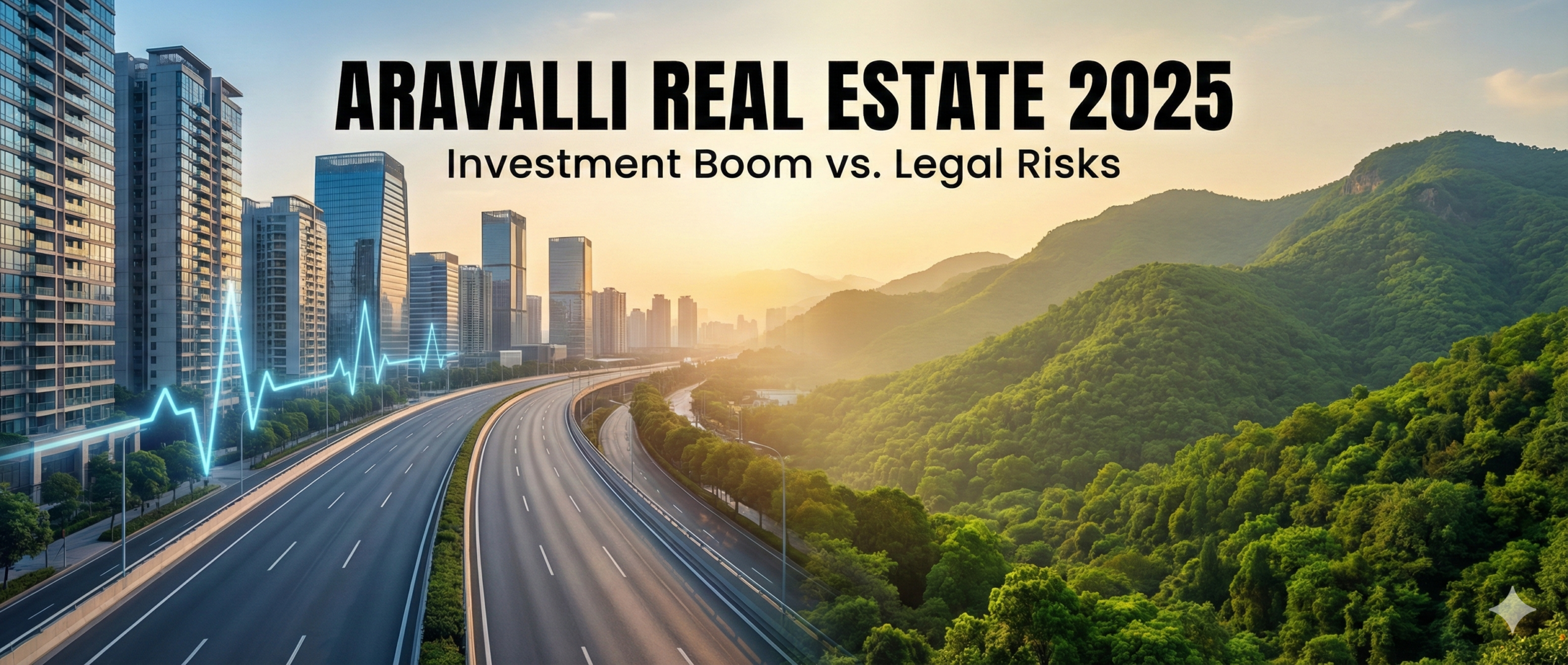
The Aravalli Hills have long stood as the ecological sentinel of the National Capital Region (NCR), shielding Delhi and Gurugram from the encroaching sands of the Thar Desert. However, for the real estate sector, this ancient mountain range represents something entirely different: a battleground between high-stakes luxury development and strict environmental conservation. In late 2025, the landscape of Aravalli real estate shifted dramatically due to new Supreme Court rulings, aggressive demolition drives, and a surging demand for green living. This blog provides a full informative guide for investors and customers, breaking down the latest news, legal pitfalls, and the massive profit potential hidden in the foothills.
1. The New Supreme Court Ruling: Redefining Aravalli Real Estate Boundaries
The most significant update for real estate investors in 2025 is the Supreme Court of India’s acceptance of a new, uniform definition for the Aravalli Hills. For decades, the ambiguity surrounding what exactly constitutes “forest land” or “hill area” created a grey zone where unscrupulous developers sold plots that were legally vulnerable. In November 2025, the Court accepted a definition that classifies Aravalli Hills as landforms rising 100 meters or more above the local relief. This ruling is a double-edged sword that every property buyer must understand.
On one hand, this definition provides much-needed clarity. Previously, vast tracts of land in Gurgaon, Faridabad, and Nuh were locked in litigation because their status was unclear. The new “100-meter rule” effectively maps out the conservation zones where construction is strictly prohibited. For investors, this means that land falling outside this specific definition may potentially be opened for legitimate urban development and infrastructure projects, provided they clear other environmental hurdles like the Punjab Land Preservation Act (PLPA). This could unlock new land parcels for residential projects in areas that were previously stalled, potentially stabilizing soaring land prices in Gurgaon.
However, the ruling also tightens the noose around illegal encroachments. The Court has mandated the creation of a Management Plan for Sustainable Mining (MPSM) and has frozen new mining leases until strict map-verifiable boundaries are drawn. For homebuyers, this signals that the government is moving toward a “zero-tolerance” policy for projects built inside the newly defined core forest areas. If you are looking at a farmhouse or a plotted development that claims to be “in the lap of nature,” you must verify if it sits on a hillock that meets this new 100-meter criteria. If it does, it is likely protected land, and your investment could be worth zero.
Furthermore, the Ministry of Environment, Forest and Climate Change (MoEFCC) is pushing the “Aravali Green Wall Project,” a massive ecological corridor aimed at restoring degraded land. This initiative will likely create a buffer zone where commercial activities are restricted. Real estate developers are now required to be far more transparent about their land banks. The era of buying “uncultivated hill land” (Gair Mumkin Pahad) in hopes of future regularization is officially over. The legal framework has hardened, and due diligence is no longer optional—it is a survival mechanism for your capital.
2. Sohna Road & South Gurgaon: The Rise of Luxury Investment Corridors
While the core hills are being protected, the foothills and adjacent areas are witnessing a massive real estate boom. Sohna Road, often dubbed “South Gurgaon,” has emerged as the primary beneficiary of the Aravalli advantages without necessarily carrying the legal baggage of forest encroachment. According to market data from late 2025, property prices in Sohna have jumped by nearly 74% over the last three years. This surge is driven by a fundamental shift in buyer psychology: the post-pandemic desire for wellness living away from the pollution of central Delhi.
The Sohna real estate market has transitioned from an “affordable housing” hub to a destination for luxury living. Developers are capitalizing on the scenic views of the Aravalli range to market premium gated communities, low-rise floors, and high-end villas. The key selling point here is connectivity combined with ecology. The Delhi-Mumbai Expressway, which passes through this region, has dramatically reduced travel time to business hubs like Cyber City and the Indira Gandhi International Airport. Investors who bought land here in 2021 are now sitting on massive equity gains, and the trend shows no sign of slowing down.
New projects in Sector 33, Sector 36, and Sector 49 are specifically designing units that offer “unobstructed Aravalli views.” In the world of luxury real estate, a view of the hills is a premium amenity that commands a price 15% to 20% higher than non-view units. This “view premium” is similar to the “sea-facing” premium seen in Mumbai. For end-users, living in South Gurgaon offers a micro-climate that is often 2-3 degrees cooler than the concrete jungles of Udyog Vihar, thanks to the green cover of the nearby hills.
However, investors should be wary of the “ripple effect” price inflation. As Sohna becomes expensive, demand is spilling over into Nuh and deeper into the Mewat region. While these areas are cheaper, they lack the social infrastructure—schools, hospitals, and malls—that Sohna now boasts. The “Goldilocks zone” for investment right now is the corridor between Golf Course Extension Road and the main Sohna town. Here, the infrastructure is ready, the Aravalli backdrop is stunning, and the legal titles are generally cleaner than the deep interior lands. Rental yields in this corridor have also risen, with 3BHK apartments commanding rents upwards of ₹45,000 per month, attracting buy-to-let investors.
3. The “Green Wall” & Farmhouse Demolitions: Risks for Unverified Land
If the previous section highlighted the boom, this section highlights the bust. The most critical news for Aravalli real estate investors in 2025 is the aggressive demolition drive targeting illegal farmhouses. In late 2025, the Gurgaon District Administration and Forest Department cleared over 25 acres of encroached land in the Raisina Hills and Sohna areas. These were not slum dwellings; these were luxury farmhouses, boundary walls, and private retreats owned by high-net-worth individuals who believed their influence could bypass the law.
The area known as Raisina Hills (not to be confused with the seat of government in Delhi) has been a hotspot for illegal colonization. The land here is often classified as “Gair Mumkin Pahad” (uncultivable hill land), which falls under the protection of the Punjab Land Preservation Act (PLPA), 1900. Despite this, hundreds of farmhouses were built over the last two decades. The recent Supreme Court orders and the National Green Tribunal (NGT) have compelled the Haryana government to act. The message is clear: structures built on forest land will be razed, regardless of how old they are or who owns them.
For a potential buyer, this creates a massive risk profile for “farmhouse living” projects. Many property agents still try to sell plots in these green zones, promising that “regularization is coming soon.” This is a trap. The Aravalli Green Wall Project aims to create a continuous ecological barrier, and the state cannot regularize land that is essential for this barrier. Buying land without a Change of Land Use (CLU) certificate or purchasing land notified under Section 4 or 5 of the PLPA is essentially burning your money.
The demolitions also affect the resale market. Properties that were once valued at several crores are now finding no buyers because the title deeds are tainted by forest notification issues. Even if a structure is not demolished immediately, it cannot be legally renovated, sold with a bank loan, or registered. Banks and Housing Finance Companies (HFCs) have completely stopped lending for properties in these “Red Zones.” If you are approached with a deal that seems “too good to be true” for a massive plot in the Aravallis, it is almost certainly PLPA-notified land. The disadvantage here is total capital loss, contrasting sharply with the safe, approved developments just a few kilometers away in the residential sectors.
4. Ecological Premium: Why Aravalli-Facing Homes Command Higher Prices
Moving away from the legalities, let’s look at the market dynamics driving the demand. Why is everyone rushing to buy near the Aravallis? The answer lies in the Ecological Premium. As pollution levels in the NCR hit severe peaks every winter, the Air Quality Index (AQI) has become a primary driver of real estate value. Studies and local anecdotes suggest that areas abutting the Aravalli biodiversity park and the southern ridge enjoy significantly better air quality than central Delhi or Noida.
The Aravalli range acts as a natural set of lungs. The dense vegetation absorbs particulate matter and acts as a barrier against dust storms from the west. For luxury homebuyers, health is the new wealth. Projects located in Sector 76, Sector 77, and Sector 79 in Gurgaon are marketing themselves as “Oxygen Zones.” This is not just marketing fluff; the temperature difference and air freshness are palpable. This environmental advantage makes these properties highly resilient to market downturns. Even when the general market is flat, Aravalli-facing units retain their value because their supply is geographically limited—you cannot manufacture more hills.
Furthermore, the scenic advantage offers a lifestyle that is rare in urban India. Living in a high-rise apartment with a view of a 670-million-year-old mountain range offers a sense of exclusivity and peace. This attracts a specific demographic: Expats, CXOs, and senior corporate leaders who work in Cyber City but want a quiet retreat for their home. This demographic profile ensures that the neighborhood quality remains high, which in turn boosts property appreciation.
Another hidden advantage is groundwater security. The Aravallis are the primary groundwater recharge zone for the region. While water scarcity is a major issue in Gurgaon, areas closer to the hills often have better water table levels (though extraction is strictly regulated). Real estate projects in these zones often integrate rainwater harvesting that feeds directly into the natural aquifers, making them more sustainable in the long run. For the environmentally conscious investor, putting money into green-certified buildings near the Aravallis aligns financial goals with ecological values. The disadvantage, however, is that these “premium” features come with a high ticket size and high maintenance charges, as maintaining luxury amenities in a semi-wild environment requires significant upkeep against dust and insects.
5. Infrastructure Boom: Connectivity Transforming the Aravalli Foothills
The narrative of the Aravallis is no longer just about “forests”; it is about “forests connected to the world.” The massive infrastructure upgrades in 2024 and 2025 have transformed the foothills from isolated retreats into accessible suburbs. The biggest game-changer is the Delhi-Mumbai Expressway (DME). The starting point of this expressway in Sohna has effectively turned the region into a logistics and residential hub.
For investors, the rule of thumb is “follow the infrastructure.” The DME allows residents in Aravalli foothill projects to reach Jaipur in under 3 hours and access other parts of Haryana with ease. Additionally, the Kundli-Manesar-Palwal (KMP) Expressway provides a bypass for heavy traffic, decongesting the internal roads of Gurgaon and making the commute from the hills to the office districts smoother.
Another critical development is the proposed Metro connectivity extending towards Sohna Road and New Gurgaon. The expansion of the Rapid Metro and the new lines approved under the Gurgaon-Manesar Urban Complex plan will bridge the last-mile gap. Real estate values historically jump by 15-20% the moment a Metro station is operationalized. Investors entering the market now, before the tracks are fully laid, stand to gain the most from this appreciation.
Moreover, the Haryana Orbit Rail Corridor (HORC) is set to run along the KMP Expressway, further boosting connectivity for the industrial sectors near the Aravallis. This industrial growth drives demand for residential housing—not just luxury villas, but also affordable rental housing for the workforce. This creates a dual-market opportunity: high-end villas for the bosses, and mid-range apartments for the workforce, all located within the shadow of the Aravallis.
However, this rapid urbanization brings a disadvantage: Traffic congestion at key bottlenecks like Rajiv Chowk and Subhash Chowk remains a challenge until the new flyovers and underpasses are fully synchronized. Also, the construction of these highways has faced pushback from environmentalists who argue that wildlife corridors (for leopards and hyenas) are being severed. Ethical investors should look for projects that respect these corridors, as “human-animal conflict” is a rising issue in these newly connected zones. A property that is constantly in the news for leopard sightings might face a temporary dip in rental demand from fearful tenants, although it adds to the “wild” allure for others.
6. Investment Guide 2025-2026: Balancing High Returns with Legal Safety
As we look toward 2026, the investment outlook for Aravalli real estate is bullish but requires extreme caution. To wrap up this guide, let’s summarize the actionable advantages and disadvantages and provide a checklist for investors and customers.
Advantages:
- High Appreciation Potential: With Sohna and New Gurgaon establishing themselves as luxury hubs, capital appreciation is expected to outperform the NCR average.
- Quality of Life: Superior air quality, lower temperatures, and scenic beauty are unmatched.
- Limited Supply: The Supreme Court ban on expanding into the forest ensures that the supply of “hill-view” inventory is capped, creating scarcity value.
- Infrastructure: World-class expressways have solved the connectivity crisis.
Disadvantages & Risks:
- Legal Uncertainty: The definition of “forest” can still be litigated on a case-by-case basis. PLPA notifications are complex and can trap unwary buyers.
- Demolition Risk: Buying resale farmhouses or unapproved plots carries a high risk of total loss due to government clearance drives.
- Water Scarcity: Despite being a recharge zone, the extraction of groundwater is restricted. Projects dependent solely on tankers are risky.
- Construction Bans: Winter pollution often leads to GRAP (Graded Response Action Plan) bans on construction, delaying project possession by months.
The Investor’s Checklist: Before signing any check for a property near the Aravallis, you must ask for:
- CLU (Change of Land Use): Ensure the land is converted for residential use.
- Forest NOC: A “No Objection Certificate” stating the land is not part of the protected forest area under the new 100-meter definition.
- RERA Registration: Never buy in a project that is not registered with Haryana RERA.
- Aravali Notification Check: Verify if the specific khasra number falls under the 1992 Aravali Notification which restricts “gair mumkin pahad” land usage.
In conclusion, the Aravalli Hills offer the most exciting real estate opportunities in North India today, blending the serenity of nature with the speed of modern infrastructure. However, the days of “wild west” investing are over. The market has matured, the laws have tightened, and the courts are watching. For the smart, informed investor who sticks to RERA-approved projects in designated residential sectors like Sohna and New Gurgaon, the hills are paved with gold. For those chasing illegal farmhouse dreams, the hills are a legal cliff edge. Choose wisely.
Aravalli Land Investment: Due Diligence Checklist
This table is designed for investors to print out or save when visiting property sites in the Aravalli region (Gurgaon, Sohna, Nuh, Faridabad).
| Category | Document / Action Item | Why It Is Critical | Red Flag (Walk Away) |
| Land Status | CLU (Change of Land Use) | Proves the government has authorized the conversion of agricultural/hill land for residential/commercial use. | Developer says “CLU is applied for” or “in process.” (Only buy after approval). |
| Forest Laws | Forest NOC (No Objection Certificate) | Confirms the plot does not fall under the “protected forest” definition (Supreme Court 100m rule). | The plot is described as “Gair Mumkin Pahad” (uncultivable hill) in revenue records. |
| Legal Acts | PLPA Notification Check | Verifies if the land is notified under Section 4 or 5 of the Punjab Land Preservation Act, 1900 (construction is banned here). | The land agent claims “PLPA is old law, it doesn’t apply anymore.” (It absolutely does). |
| Verification | Jamabandi (Revenue Record) | Establishing the true owner of the land. Verify the “Khasra Number” against the Forest Department’s maps. | The seller is selling via “Power of Attorney” (GPA) only, without a registered sale deed. |
| Approvals | RERA Registration Number | Ensures the project is registered with Haryana RERA, protecting your money in an escrow account. | Project has no RERA ID or the ID provided does not match the Haryana RERA website database. |
| Site Check | Physical Survey | Check for “demolition markers” or notices from the Forest Dept/MCG on the boundary walls. | Signs of recent demolition nearby, or the plot is located inside a dense cluster of trees/hills. |
| Financial | Bank Loan Eligibility | Banks do strict due diligence. If a bank refuses to fund a project, it usually has legal flaws. | “Developer financing only” or “Cash deals only.” (Major signal that banks have blacklisted the land). |