When homebuyers compare residential projects, they usually focus on location, apartment size, price, builder reputation and amenities. One factor receives much less attention even though it can dramatically change everyday living: apartment density Bangalore Delhi NCR Hyderabad.
*Price and availability are accurate at the time of publishing. Verified by Property Specialists.
Apartment density broadly describes how many homes are planned on a given land parcel. The simplest comparison is often units per acre, but density should never be judged through that number alone. Tower height, tower spacing, landscaped area, podium coverage, parking design, lift count, clubhouse capacity and the proportion of genuinely usable open space all affect how crowded—or spacious—a community feels.
Consider two projects.
Project A may have 80 apartments per acre but use tall towers placed around large landscaped zones.
Project B may have only 65 apartments per acre but spread shorter blocks across much more of the site.
Despite the lower numerical density, Project B may actually feel more built-up at ground level.
That is why buyers comparing tower density, open space ratio and high rise community planning need to look at the entire master plan rather than one marketing statistic.
Current projects across India’s major residential markets illustrate how different the density spectrum can be.
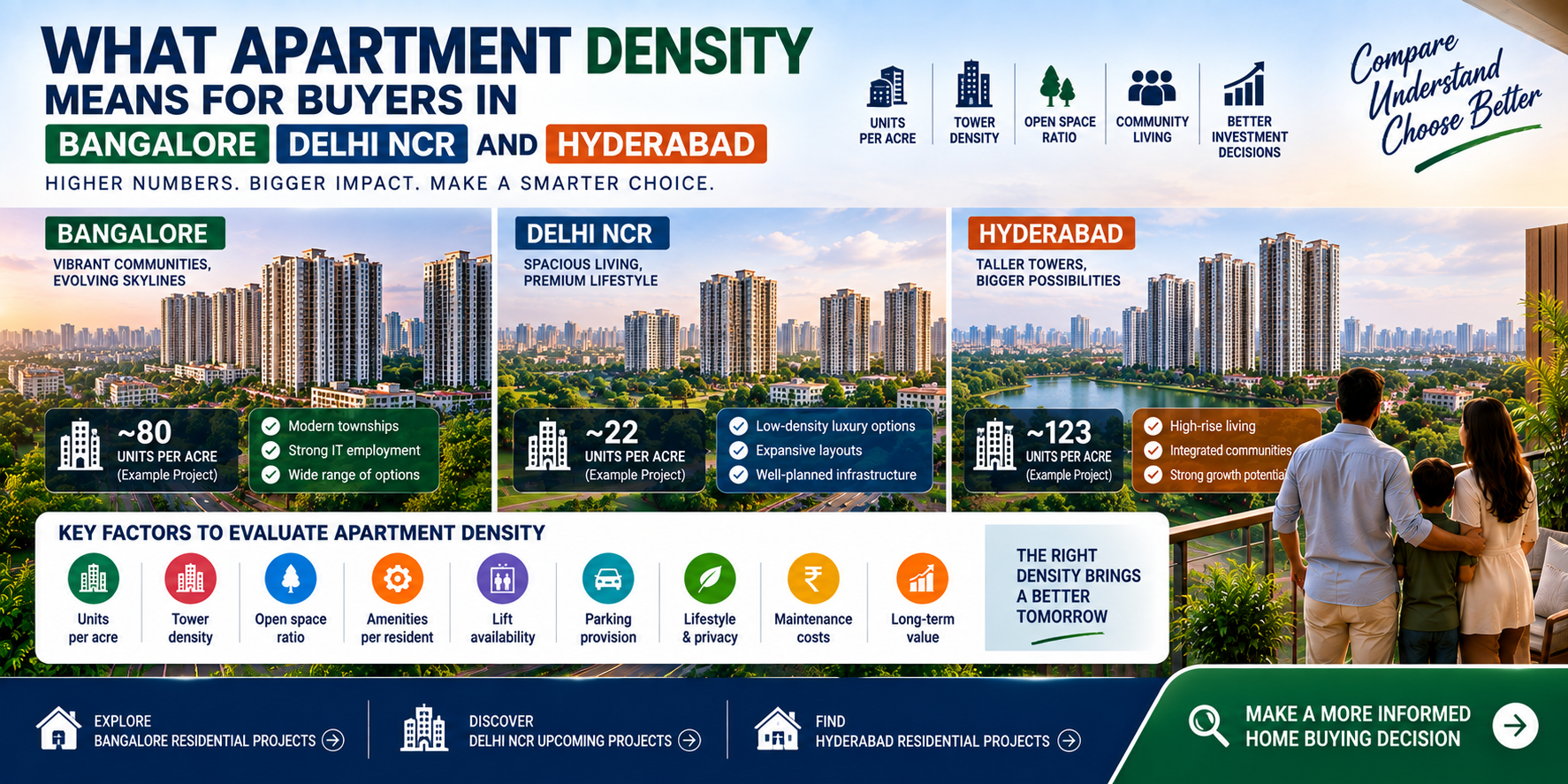
In Bengaluru, Evergreen at Prestige Raintree Park is currently listed with around 2,000 apartments across 24.73 acres, which works out to roughly 81 homes per acre. The development contains 14 buildings and a mix of 1 to 4 BHK apartments.
In Noida, UP-RERA-based data for Estate 128 records approximately 218 units across 9.73 acres, equivalent to roughly 22 homes per acre, demonstrating a much lower-density premium planning model.
In Hyderabad, Prestige Clairemont in Neopolis has 928 residences on 7.56 acres, equivalent to roughly 123 units per acre, while My Home Nishada has about 1,398 homes across 16.68 acres, or approximately 84 units per acre.
These numbers do not mean that one project is automatically better than another. Higher density can reduce maintenance cost per household, create more community activity and support extensive amenities. Lower density can improve privacy, lift availability, clubhouse access and perceived exclusivity.
The correct question is therefore not:
“Is this a high-density project?”
It is:
“Does the project’s density work well with its tower spacing, amenities, infrastructure and apartment pricing?”
This guide explains how buyers should evaluate apartment density Bangalore Delhi NCR Hyderabad, what units per acre really tell you, how open-space claims should be interpreted and when a high-rise community can still feel spacious despite having hundreds or thousands of homes.
1. What Does Apartment Density Actually Mean for a Homebuyer?
The most common way to measure residential density is units per acre.
If a project has 1,000 apartments across 10 acres:
Density = 100 homes per acre
If another project has 400 apartments across 10 acres:
Density = 40 homes per acre
At first glance, the second project seems dramatically more spacious.
But that number is only the starting point.
Why Units Per Acre Matter
Higher units per acre generally means more households sharing the same project infrastructure.
This can affect:
Lifts
Clubhouse
Swimming pools
Internal roads
Visitor parking
Security
Entry/exit gates
Children’s play areas
Sports courts
Water systems
For example, a clubhouse designed for a 500-home community may feel very different from the same-sized clubhouse serving 2,000 homes.
But Density Is Not the Same as Ground Coverage
Imagine two 10-acre projects.
Project A
800 apartments
8 towers
35 floors each
Limited ground coverage
Project B
600 apartments
20 shorter buildings
More land occupied by structures
Project A has higher numerical density but could still provide more continuous landscaped open space.
This is one reason high-rise design is increasingly used in land-constrained metro markets.
Tower Density Matters Too
Buyers should examine how closely towers are positioned.
Ask:
How many towers are there?
How many apartments per floor?
What is the tower-to-tower distance?
Are balconies directly facing another tower?
Is there enough daylight at lower floors?
Do living rooms overlook landscaping or another building?
Two projects with identical units per acre can offer very different privacy depending on these factors.
Lift Density Is Often Overlooked
Suppose a tower has 200 apartments and four passenger lifts.
That creates roughly 50 apartments per lift.
Another tower may have 300 apartments and only four lifts.
That means roughly 75 apartments per lift.
At peak times—school mornings, office hours or evenings—this can materially affect resident experience.
Buyers should ask:
Passenger lifts per tower
Service lifts
Homes per floor
Total tower population
Community Density Checklist
Metric
What Buyers Should Check
Units per acre
Overall residential intensity
Homes per tower
Tower population
Homes per floor
Privacy and corridor traffic
Homes per lift
Waiting-time pressure
Tower spacing
Light, privacy and views
Clubhouse per home
Amenity capacity
Parking ratio
Daily convenience
Ground coverage
Actual open areas
Density Is Neither Good Nor Bad by Itself
A well-designed 100-unit-per-acre development can outperform a poorly designed 50-unit-per-acre project.
What matters is whether infrastructure scales with population.
For buyers comparing Bangalore residential projects, this distinction is especially important because Bengaluru now contains everything from low-density luxury communities to township-scale projects with thousands of apartments.
2. Bangalore: Township Density vs High-Rise Efficiency
Bengaluru’s residential market provides some of the best examples of how density can vary even within one city.
Land values in Whitefield, Sarjapur Road, Hebbal and other established corridors have increased substantially, encouraging developers to build taller residential towers and larger integrated townships.
Prestige Evergreen / Raintree Park Example
Current Housing.com project information lists Evergreen at Prestige Raintree Park with:
Approximately 2,000 apartments
Around 24.73 acres
14 buildings
1, 1.5, 2, 3, 3.5 and 4 BHK formats
That produces an approximate density of:
2,000 ÷ 24.73 = 80.9 homes per acre
This is a useful example of a large-scale modern township phase where density is balanced through multiple towers and extensive common infrastructure.
Why 80 Homes Per Acre May Still Work
Suppose the project offers:
Well-separated towers
Large landscaped podium
Multiple recreational zones
Adequate parking
Large clubhouse
Efficient lift design
In that situation, the community may still feel comfortable despite having around 81 apartments per acre.
The quality of high rise community planning becomes more important than the raw number.
Whitefield and Sarjapur Road Are Different From Older Bangalore
Modern East Bengaluru projects often include:
30+ floor towers
Podium parking
Central landscaped spaces
Large clubhouses
Sports infrastructure
Older apartment communities may have fewer units but more surface parking and lower landscaping ratios.
Premium Projects Can Be Lower Density
At the other end of the spectrum, premium Bengaluru projects may use:
Larger apartments
Fewer units
Wider tower spacing
Lower resident population
These developments generally command higher ticket sizes because the land cost is distributed across fewer homes.
Density and Maintenance Cost
Bangalore buyers should understand an important trade-off.
A low-density project may have:
fewer residents
more privacy
but also:
fewer households sharing security costs
fewer households sharing landscaping
fewer households funding club maintenance
This can push maintenance higher.
A high-density township may have expensive infrastructure but thousands of households sharing the expense.
What Bangalore Buyers Should Prioritise
For a large apartment community, check:
Number of entry gates
Internal road width
Drop-off zones
Lift count
School-bus management
Clubhouse size
Pool count
Visitor parking
Open-space continuity
Bangalore Density Profile
Project Type
Typical Buyer Experience
Boutique luxury
More privacy, higher cost
High-rise premium
Efficient land use
Integrated township
High unit count but extensive infrastructure
Older low-rise
Lower vertical density but potentially more ground coverage
Key Bangalore Lesson
Do not reject a project simply because it has 1,500 or 2,000 apartments.
Instead ask:
How much infrastructure has the developer created for those 2,000 households?
That is the more useful density question.
3. Delhi NCR: Why Low-Density Luxury Has Become a Major Selling Point
Delhi NCR, particularly Gurgaon and premium Noida, has seen developers increasingly use low density as a luxury positioning tool.
The idea is simple:
Fewer homes on a valuable land parcel can create:
Greater privacy
Larger apartment sizes
Fewer neighbours
More open landscaping per resident
Lower lift congestion
More exclusive amenities
Estate 128 – A Low-Density Example
UP-RERA-derived project data for Estate 128 records:
approximately 9.73 acres
around 218 units
4 towers
This translates to only about:
22 homes per acre
That is dramatically lower than many large high-rise projects in Bangalore or Hyderabad.
Why Developers Use Low Density in Premium NCR Projects
A lower tower density can allow:
larger apartments
more landscaping
better views
wider separation
quieter common areas
However, buyers pay for that exclusivity.
If land cost is divided across fewer apartments, each home’s share of land value becomes much higher.
Godrej Riverine – Another Noida Example
UP-RERA-derived data for Godrej Riverine, Sector 44 indicates approximately:
6.46 acres
about 429 sanctioned/planned units in the referenced dataset
derived density around 66 homes per acre
Other marketing databases use slightly different home counts, demonstrating why buyers should verify density through sanctioned or RERA records rather than relying on promotional numbers alone.
The important point is that Riverine is still positioned as a relatively low-density premium project compared with several large urban high-rises.
NCR Density Depends Heavily on Market Segment
You may find:
Luxury Gurgaon / central Noida
Lower unit density
Larger apartment sizes
Higher ticket values
Greater Noida / Noida Extension
Larger township populations
More towers
More mass-market configurations
This makes city-level comparisons difficult.
Density and Resale Positioning
Low density can become a resale advantage if future buyers value:
Privacy
Low crowding
Larger landscaped areas
Fewer apartments
But extremely high ticket size can reduce the resale buyer pool.
Buyers exploring Delhi NCR upcoming projects should also compare project density across Noida, Gurgaon and Greater Noida because the same budget can buy very different community environments.
4. Hyderabad: Why Tall Towers Can Produce Very High Units Per Acre
Hyderabad’s western corridor provides perhaps the clearest example of modern vertical density.
Areas such as Kokapet and Neopolis have seen large parcels developed with towers rising 35, 40 or more floors.
This allows developers to place hundreds of apartments within relatively compact land parcels.
Prestige Clairemont Example
Prestige Clairemont in Neopolis has:
7.56 acres
928 residences
4 towers
That produces a density of approximately:
123 homes per acre
The figure is supported by project records and derived density calculations.
At first glance, 123 homes per acre sounds extremely dense.
However, the project uses high-rise towers and podium-based planning, allowing the residential population to be concentrated vertically.
My Home Nishada Example
My Home Nishada has approximately:
16.68 acres
1,398 homes
8 towers
Approximate density:
1,398 ÷ 16.68 = 83.8 homes per acre
Despite having more total apartments than Clairemont, Nishada has a substantially lower units-per-acre figure because it occupies a much larger site.
Rajapushpa Pristinia Shows an Even Higher Figure
ApartmentFacts’ RERA-based review of Rajapushpa Pristinia records:
approximately 12.11 net acres
1,782 homes
density of about 147 homes per acre
This demonstrates the level of vertical residential intensity now possible in Hyderabad’s premium western corridor.
Does 147 Homes Per Acre Mean Poor Livability?
Not automatically.
A development can still work if it provides:
sufficient lifts
tower spacing
large podium landscaping
clubhouse capacity
internal circulation
parking
water infrastructure
But the margin for poor planning becomes smaller.
Clubhouse Pressure Matters More in High Density
Imagine a 50,000 sq. ft. clubhouse.
If 500 apartments share it:
100 sq. ft. of clubhouse per home
If 1,500 apartments share it:
33 sq. ft. per home
This is not a formal industry metric, but it illustrates how buyers can test whether amenities are proportionate to the resident population.
Hyderabad Buyer Checklist
In Kokapet/Neopolis projects, ask:
Units per acre
Number of towers
Lift ratio
Homes per floor
Podium size
Open-space design
Clubhouse size
Swimming pool capacity
Parking bays
Water and STP capacity
Hyderabad’s tall towers can create spectacular views and modern urban design, but buyers need to verify whether common infrastructure scales with the number of residents.
5. Open Space Ratio: Why the Marketing Percentage Can Be Misleading
“80% open space.”
“85% open space.”
“90% open area.”
These claims are extremely common in residential marketing.
But the open space ratio can be misunderstood.
Open Space Does Not Always Mean Green Space
A developer may classify multiple non-building areas as open space, including:
Internal roads
Driveways
Fire-tender movement areas
Surface paving
Setbacks
Podium landscaping
Utility areas
Therefore:
80% open space ≠ 80% landscaped gardens
Buyers should ask specifically for:
Ground coverage
Soft landscaping
Hardscape
roads
podium landscape
recreational greens
Ground-Level Green Space Is More Valuable
Imagine two projects both claiming 80% open area.
Project A
Most open area consists of:
Roads
driveway
podium paving
Project B
Most open space consists of:
Trees
lawns
parks
sports fields
The resident experience will be very different.
Check the Master Plan
The master plan should reveal:
Tower footprints
Roads
podium
amenities
landscaping
entry/exit
service zones
Do not rely only on the percentage written in a brochure.
Tower Spacing Is Part of Open-Space Quality
A project may have substantial total open space but place towers too close together.
Poor spacing can affect:
Daylight
ventilation
privacy
views
Buyers should physically inspect the site or study scale drawings.
Open Space Per Resident
A useful mental model is not just:
How much open space does the project have?
Ask:
How many residents will share that open space?
A 5-acre lawn in a 3,000-home township may feel busier than a 2-acre lawn in a 300-home project.
What Buyers Should Request
Ask the developer for:
Approved master plan
Ground coverage percentage
Landscape plan
Tower separation
Total unit count
Podium design
The more transparent the data, the easier it is to assess real density.
6. How Density Affects Privacy, Maintenance, Amenities and Resale
Apartment density influences much more than crowding.
It affects the entire ownership experience.
Privacy
Lower-density projects often have:
Fewer apartments per floor
Fewer neighbours
Quieter corridors
Premium projects may offer:
2 homes per floor
4 homes per floor
no shared walls
High-density projects may have:
6–10+ homes per floor
Neither is automatically bad, but buyer preferences differ.
Lift Waiting Time
A simple buyer metric is:
Number of homes ÷ number of lifts
For example:
Tower
Homes
Passenger + Service Lifts
Approx. Homes/Lift
Tower A
160
4
40
Tower B
300
4
75
Tower C
350
6
58
Lower ratios generally reduce waiting-time pressure.
Higher density can reduce per-household cost because more residents contribute.
However, high-density communities also create greater wear on:
lifts
pools
clubhouse
roads
common furniture
Amenities
Ask whether the project has enough:
Pools
badminton courts
gyms
children’s zones
banquet halls
for the resident population.
One swimming pool serving 300 homes is different from one pool serving 2,000 homes.
Parking
Higher density increases vehicle movement.
Check:
Parking bays per home
Visitor parking
EV charging
Entry/exit width
Resale
Density can influence future buyer perception.
A low-density premium property can command scarcity value.
A well-managed high-density township can still generate excellent resale demand because of:
brand
amenities
community scale
retail ecosystem
The real risk appears when a large project has:
poor maintenance
too few lifts
inadequate parking
overloaded amenities
Density Decision Framework
Buyer Priority
Better Fit
Maximum privacy
Low density
Lower maintenance per household
Moderate/high density can help
Large community ecosystem
Township/high density
Quiet clubhouse experience
Low density
Extensive amenities
Large township often stronger
Lower purchase ticket
Higher density can help developers spread land cost
Exclusivity
Low density
7. Bangalore vs Delhi NCR vs Hyderabad: Density Comparison for Buyers
The three markets illustrate different approaches to urban apartment planning.
Current Project Examples
City
Project
Approx. Land
Homes
Approx. Density
Bangalore
Evergreen Prestige Raintree Park
24.73 ac
2,000
~81/ac
Noida
Estate 128
9.73 ac
218
~22/ac
Noida
Godrej Riverine
6.46 ac
~429*
~66/ac
Hyderabad
My Home Nishada
16.68 ac
1,398
~84/ac
Hyderabad
Prestige Clairemont
7.56 ac
928
~123/ac
Hyderabad
Rajapushpa Pristinia
12.11 ac
1,782
~147/ac
*Based on the referenced UP-RERA-derived dataset; other public project sources show different residential-unit totals, so buyers should verify the sanctioned project schedule.
What This Table Really Shows
It does not mean:
Noida is always low density.
Hyderabad is always high density.
Bangalore always sits in the middle.
It simply shows how dramatically individual projects can differ.
Bangalore Pattern
Large integrated communities can combine moderate-to-high density with substantial amenities and township infrastructure.
Delhi NCR Pattern
The premium segment increasingly uses low density as a luxury differentiator, while Greater Noida and other mass-market locations can be considerably denser.
Hyderabad Pattern
Kokapet and Neopolis increasingly use very tall towers, allowing high units-per-acre ratios while preserving landscaped podiums and premium amenities.
Best Density for Buyers?
There is no universal ideal.
A sensible range depends on:
Tower height
Apartment size
infrastructure
clubhouse
parking
open space
project positioning
The best project is the one where the resident population and infrastructure are balanced.
FAQs About Apartment Density in Bangalore, Delhi NCR and Hyderabad
1. What does units per acre mean in a residential project?
Units per acre is calculated by dividing total apartments by project land area. For example, 800 homes on 10 acres equals 80 units per acre. It is a useful density indicator but should be considered alongside tower height, open space, lift count and ground coverage.
2. Is lower apartment density always better?
No. Lower density generally offers more privacy and fewer residents, but maintenance can be higher because expenses are shared across fewer households. Well-planned higher-density townships can offer extensive amenities and vibrant community infrastructure.
3. What is considered a high-density apartment project?
There is no universal legal threshold applicable across all cities and project types. As a practical buyer comparison, projects above 100–120 homes per acre can be considered relatively dense, while 20–50 homes per acre is generally low density. Local planning rules, tower height and apartment size materially affect the interpretation.
4. Does high-rise construction mean high density?
Not necessarily. A very tall project can have relatively few units if towers contain large apartments and limited homes per floor. High-rise construction can actually allow more ground-level open space by concentrating construction vertically.
5. What should buyers check besides open-space percentage?
Check tower spacing, ground coverage, landscaping versus paved space, homes per floor, lift ratio, clubhouse size, parking, visitor circulation and total number of residents likely to use the amenities.
6. Which city has the lowest-density luxury projects?
Premium Delhi NCR markets currently offer several notable low-density developments. Estate 128 in Noida, for example, works out to roughly 22 homes per acre based on the referenced UP-RERA dataset. Hyderabad and Bangalore also have low-density luxury projects, so project-level comparison remains essential.
Conclusion: Why Apartment Density Should Be Checked Before You Buy
The apartment density Bangalore Delhi NCR Hyderabad comparison shows why homebuyers need to look beyond apartment size and brochure amenities.
Density affects:
Privacy
Lift waiting times
Traffic inside the project
Clubhouse crowding
Swimming-pool usage
Parking
Maintenance
Landscaping
Resale perception
Current projects illustrate the full spectrum.
Estate 128 represents a very low-density premium model at roughly 22 homes per acre. Evergreen Prestige Raintree Park sits around 81 homes per acre, while My Home Nishada is in a similar broad range. Prestige Clairemont and Rajapushpa Pristinia demonstrate how Hyderabad’s vertical high-rise planning can push density above 120 or even 140 homes per acre.
None of those numbers is automatically good or bad.
The strongest project is one where:
tower density remains manageable
lift infrastructure matches resident population
open spaces are genuinely usable
clubhouse capacity is sufficient
parking and entry systems are well planned
water and utility infrastructure can support full occupancy
maintenance remains sustainable
For homebuyers, the key principle is simple:
Do not ask only how many acres the project has. Ask how many families will share those acres—and what infrastructure has been created for them.
That is the real meaning of apartment density, and it can influence everyday quality of life far more than many buyers realise before possession.

 By Upcoming Property